Showing posts with label tabletop games. Show all posts

May 17, 2013

Again with Viscerality

The combat takes up too many of the rules, and too many item slots. The descriptions of guns are 50 words, whereas water is only 5 or 10. What gives, man?

I think a lot of it comes from my experience with D&D 3.5. As I've mentioned before, D&D is a pulp fantasy simulator- meaning a huge focus on combat. 3.5 edition did away with the pulpiness, but still kept the combat focus. Notice how all D&D player's stories are about combat encounters?

So, I've tried to re-think the challenge dynamic in an RPG. I asked myself- what are the solutions to various challenges? Here's my list.
  • Combat
  • Stealth
  • Speech
  • Resources
  • Devices
  • Exploration
  • Puzzle
  • Roleplay
Combat:
Very obvious. By far the most overused solution to a problem. The gameplay is to drain the opposition's health, without losing your own. This could be an entire game. I've been thinking about future editions of the EE, and this is going to be the most prone to change.

Stealth:
My main inspiration was one of the Splinter Cell games. Using light, sound, and also smell, you could create a very compelling set of stealth rules. Much more focus on tension, rather than intensity. I like stealth because it is just as failure-prone as combat, and much more believable.

Speech:
Again, one thing I wanted to add to the EE. Let reputation and believability be the HP bars, and just run the encounter as people talking. By Sunburn 3, this is definitely going to be a feature. Obviously, it'll take some time, but it's a mechanic which I think is missing from most RPGs, and even video games.

Resources:
Overlooked in most games is the mercantilist answer. In a lot of cases, just having enough money or the right items can solve a problem in itself. Not just buying the meat shield a bigger gun, but having something designed specifically for the problem you're solving. What I try to do is model a system whereby a character can survive just by money management, and lots of bribes.

Devices:
A bit trickier. Having worked in industry, I can attest to the complexity of certain machinery. Some of it is complex enough to warrant more than one check for operation. It would be cool to make an "encounter" out of picking a lock, or disarming a trap. The problem would be, what "attacks" would you be making? Pounding it with a hammer? Manipulating it with lockpicks? Dunking it in acid? If it works, great! Otherwise, this might be a dud.

Exploration:
Not just in the geographical sense. Escape-the-room games are a good example of this mechanic, because you win by looking everywhere. I mostly think of it in a Bethesda Games sense- go here, find this, do this thing. I believe a pure exploration game would be impossible to pull off (though, playing as Lewis and Clark would be rather entertaining). But, as an added feature, I think it's great. There's going to be some content in Spectrum hidden away near the edges of maps, to encourage exploration of the world.

I like exploration as an experience, but it's pretty hard to make challenging or engaging.

Puzzle:
This one, as well as Roleplaying, are very difficult to describe in perfect detail. The purpose of a puzzle is to challenge the players through their characters. I might hand them something in real life, or describe the problem orally. Visual aids help tremendously.

Roleplaying:
By far the hardest to describe on the list. You could make an argument that it's another category in disguise, but I like to think of it like manifest destiny, or self-actualization.

The concept behind it is accumulation of knowledge, usually gained through exploration (or puzzles. All three could be lumped together as "stuff the power player doesn't care about"). Then, the application of that knowledge. It doesn't rely on the character's stats, it instead relies on the player. Immersing yourself in the lore of the world to manipulate presented events is something I really think everyone should do at least once. For some games, this is a viable technique. I can't think of very many, there are many more examples of the opposite. Think of all the games where it doesn't make a difference how much you care about the world.

Being drawn into a fictional world is an amazing experience. It makes everything so real for the players, but only if they're willing to go under the surface. If I ever devise a good example of problem solving by Roleplaying, I will definitely post it here. For now, it's a little voice in the back of my head.

~

See how many alternatives there are to combat-based gameplay? As long as there's a solid mechanic behind all of these (except the last two), almost anything could be compelling. I could make an interesting campaign out of a boring day at the post office.

January 31, 2013

Letter of Intent


 I want to put this out here, partially for myself, but also for others.


The Escapade Engine is designed to be simple, usable, and fun. It has a heavy focus on integration of other gameplay elements. This either allows for different rules and genres to be played with the same engine, or for multiple gametypes to be played at the same time. That is, I believe, its manifest destiny.

The EE will be free- I am not going to charge money for this. There won't be any books, official dice-sets, or miniature figures. It's supposed to be a good time with friends, no more- the extra money can go to pizza for late-night gaming sessions

This is the same reason I'm not going to turn Adsense onto this blog. Odds are you're here for words of questionable wisdom, not "1 simple trick to perform a coordinated air assault on a stationary target," or similar.

So, whoever you are, game on!

~

"But why not play GURPS?"
-I like English, not physics. The EE has a focus on being easy to use, something GURPS fails at. Same goes for most D&D games, which put too much of an emphasis on combat encounters for my liking.

"I had, like, this really cool idea for a thing. Can I do it?"
-Of course. The rules should be simple enough that you can just wedge it in.

"I'm very impressed, or uniquely offended- how do I get into contact with you?"
-Send me an email at escapadeengine@gmail.com

January 27, 2013

The ideal Tabletop-Gamer

This one's really opinionated. It represents my views as of now, and is not an absolute truth. It's just what I think is best at the moment.

We game for escapism. Everyone does. It's why we watch TV, play video games, and go to art galleries. Escapism isn't necessarily pretending you're an elf in space, but just NOT being who you are every day of the week.

Mark Hermanson is a good guy to be, but sometimes I want to be someone else. Watch the movie "Darkon," they've got some good quotes on this one.

So, my first suggestion for an ideal player is someone who wants to escape from real life for a little bit. Look for the quiet ones who wear dark colors. Someone who doesn't fit in, and really doesn't want to. The outcasts, loners, and social pariahs that our world creates have some of the most amazing things in their heads.

Gaming is storytelling. The best players (doubly so, the best GMs) are the ones who want to make a convincing narrative that everyone can enjoy. The game is secondary, but still a very strong factor. For this reason, people with Roleplaying experience (and not just from team-building exercises at work) are some of the best gamers.

Similarly, players with experience in creative writing, movie and literary appreciation, or even a thoughtful video gamer are also good candidates. Someone who can understand story, and have an awareness of the devices surrounding them, will mesh incredibly smoothly with a good group. Problem-solvers usually aren't good, because Gaming isn't about finishing the game- it's about playing it.

The journey is more important than the destination... but the destination is still pretty awesome.

Creative, enthusiastic minds are the best for creative characters. Even if the character is really boring, the player should be able to make them into a compelling piece of the narrative. This one I'd put as less important, because compelling stories still happen around otherwise bland characters, especially if the players catch on.

These are some loose thoughts, accumulated over the last couple of weeks. I was considering putting this in Bite-sized thoughts 2, but it's a little big for that.

Recap:
  • A desire to escape reality for a few hours
  •  Previous experience as a role-player
  • A basic understanding of narrative mechanics and storytelling
  • Patience to be in the game, and enjoy the experience, rather than trying to finish it
  • Creativity to lend vibrancy and compelling personalities to characters
These are just my thoughts on the matter, and are not absolute in any way. Think of them as "positive traits." They help, but are not necessary to have an enjoyable experience.

And, in the end, that's really all that matters: having a positive experience.

January 20, 2013

Player vs Character

Still buggering around with rules.

I'm worried that I've made it all too complicated. Check out this page: EE Core Skills

It was inspired mostly by Fallout. I wanted a well-rounded universal system- not complicated enough to have forty gazillion attributes (Looking at you, Shadowrun), but complicated enough to have definable characters inside the rules. I'm all for three attributes (Combat/Movement/Special would be my choice), but that's not the point.

Rules are a way to express story. A tough character will have a high strength score, mechanically allowing him to do tough things. He's much more likely to punch through a door than go shopping for tuxedos. That doesn't mean he can't dress up, but that's not how he usually works. There's a certain oracular power in the stats: each number is a chance of him/her performing that action. Higher numbers are more likely for that character.

"I've got 16 Strength and 3 Coordination- I think I'll try to pick the lock on this door" said no one ever.

A character sheet should tell a character's story. You should be able to look at it, and know basically who they are and what they do. A classical gunslinger will have high toughness, coordination, and reflex. An astronaut will have high education and coordination. An actress will have enough personality to flip over a bus. Etc. Suppose the astronaut goes into movies later in his career? He'll start buffing his personality.

This brings a certain paradox, though; characters become more and more identical the further away they are from the middle of the stats balance.

At XP 0, characters have no stats. No bonuses to any rolls whatsoever. Same HP, same Fatigue, etc. The only difference is player personality, and equipment choice. As they get more XP and pick up better stats, they start to differentiate. There will be tough guys, smart guys, sneaky guys, etc. Even more stats, and they start to fall into archetypes. This is where a character's actions can become more defined by what stats they choose, because of distance between often-used and dump stats. Cowboys, astronauts, and astronaut cowboys start to emerge here.

But, as they max out more stats at the 20 point, they get more identical. The only thing left to spend points on (aside from perks, which I'm planning to incorporate later on the EE's development), is lower skills. The bottom line of their skills rise. The gunslinger becomes well educated, and the actress gets enough toughness to survive a strafing run. This continues, until everyone hits 20 in all stats- identical, again. Just like the beginning, the only thing setting them apart from each other is player personality.

So, my answer is to cut off the characters before they make it to the end, where nothing (aside from the truly insane- not out of the picture) is challenging. Everyone loves a good character, but once they reach that God-level... what's the point? They're all interchangeable, and the only thing setting them apart is equipment. This could be used to narrative effect, but I can't see it right now. Maybe later.

Consequently, I don't like the idea of starting characters at 0 XP without a good purpose. It could be a metaphor for identity, and finding a purpose, but I plan to start Project Sunburn by divvying up 210 XP between the characters evenly, and letting them customize from there.

~Intermission~

Now that I've rambled around about the interplay of numbers and stories, let's get to the meat of the issue. Players versus characters.

inb4 characters kick player's asses.

Tabletop games are all about the escapism. The purpose is to be someone else, instead of just watching them- like in movies. Video games (and some sculptures) are the closest entertainment venue, with players having meaningful interactions to the piece of work. To quote Darkon, "You could watch Brad Pitt, or you could be Brad Pitt."

Old-school D&D had the right idea. The players are the character's brains. They analyze the data, work out puzzles, and make the shots. If there was a puzzle, then dammit, YOU had to figure it out.

But, with the advent of knowledge checks, the player is really just guiding the character around to look at things. See a strange alien device which takes metal in and spits out odd-looking devices? Roll the dice, and it's a grenade-maker. Odd picture on the wall? Roll the dice, it's the tribal creation story.

Escapism means having characters stronger, smarter, and usually better-looking than us (When was the last time anyone made a deliberately ugly character? The last time I remember was about three years ago, and it wasn't me). Stronger is easy with numbers- your fist makes short work of the wooden door. But smarter is a little more difficult. I choose to think of it as pure encyclopedia knowledge. If the grenade-maker is in the basement of a candy shop, it's up to the player to figure out if anything is seriously wrong. It makes the player feel smarter, and more involved.

The only downside is the player NOT getting the implications of what they see and identify. If so, they have my pity. But it is a game, after all. To quote my psychology course, "the approximate truth is better than no truth at all." I've been leaning on that a lot recently.

Ow, my head. I think I've ran my mouth enough for the time being.

December 10, 2012

Simulation vs Narrative

This is something that's been on my mind for a while.

The traditional spirit of wargames was simulation- how would you command Napoleon's forces, etc? It was a scenario, a simulation. You could go back to the same battle and do it over and over again. It would never get boring because your (hopefully) human opponent would also be adapting.

The spirit of Tabletop RPGs, however, was narrative. It's bad taste to do the same dungeon more than once, maybe twice. Because then everyone knows the play of it- it's hardly unexplored territory with unexpected surprises.

So, unlike a wargame, an RPG has basically no replay value. One and done. The GM, and the players, get one chance to go through a mission which may have taken days (or months, in Sunburn's case) to make.

Things get even more complicated with multiple options inside the constructed scenario. Let's say there's only one choice players can make at any time- fight, flight, or socialize.

Highlighting all of the choices let the players tailor it to their needs. This group is good at talking, so they will socialize their way through the problem. That group can kill hundreds and hundreds of enemies- their option of choice is "fight."

Each option has a certain amount of gameplay. Enemy maps for the fight option, terrain challenges for the flight option, and new characters to interact with for the "socialize" option. No matter which choice the PCs take, they miss a certain amount of gameplay. But they have choice.

If I leave it to the players to pick their own course of action, the same thing happens. Either they "find" one of my pre-made options, or they make their own, and it's up to me to improvise. Still a loss of gameplay, even if they don't know about it.

So, a truly "completionist" story has only one option- no missed gameplay. There is one option. You must complete it this way, in a fine tradition of stoicism.

On the flipside, a simulation has no missed gameplay, because it gets replayed up to an infinite amount of times.

But, in order to achieve that, I need to be able to constantly adapt to any player's tactic. That sounds really tedious, after the third time or so. So, for the time being, I'm fine on the narrative side of the fence.

Sunburn's coming, I promise- I just need to make sure it doesn't explode.

November 7, 2012

On player death

It would be all too easy to just let players be conveniently invincible. But then it's not really a challenge- it's sightseeing. Don't get me wrong, I like sightseeing, but there needs to be an element of challenge and fear involved. If you really mess up, you will die. Your resources, including your HP, will be fatigued and exhausted. But that's not fun!

My policy (both for RPs and RPGs) was that no one will die... permanently. It served its purpose nicely, but there was still no viscerality to it. I could make a convincing firefight, but eventually someone will realize- there never was any real danger. There never will be. We can do what we want, and the GM will have to go with it. I'm invincible!

So, I'm putting up new ground rules. This is still a loose guideline, and heavily ties into the "you're special" intro to every campaign evar.
  • Players get a "warning shot." Unless if it very obviously should kill them (detonating a nuke), my dice will conveniently miss them. Hopefully they'll get the idea and scramble for meds.
  • Anyone who dies will get to go out in the most spectacular way possible. No boring deaths. If they're going to die, then dammit! I'll give them an exit they'll remember for quite a while.
  • Resurrect: The character comes back to life, but at a cost. Either XP, or something nasty comes with them.
  • Reincarnate: Make a new character with roughly the same XP. I don't want death to be a character replacement mechanic, but at the same time, I'm not going to punish them too thoroughly for dying. The dice are trying to kill me.
This is roughly how I'm going to do things. Warning shot -> spectacle -> resurrect/reincarnate.

In Sunburn, they'll have defib shockers which bring them up to 1 HP. I'll even make them roll dice for it. Certain negative HPs have harder and harder DCs to beat.

(Medicine) + (Ability Dice, D8 for humans) vs Second Wind DC
  • 0-10 : DC 4
  • 11-20: DC 6
  • 31-50: DC 9
  • 51-100: DC 12
It'll work for now. More will happen in testing. For a couple of people slugging it out with machine guns doing +2 over the "light" armor, I think we're good.

November 1, 2012

On the nature of RPGs

So I was reading Grognardia the other day. He had some good points about story, and the "essense" of 1e. But, most importantly, he directed me to a page about Gygax: Story is more important than gameplay.

In this day of high-fidelity video games, the mechanics of any tabletop game are sorely outdated. It's easier to make a "game" for pen and dice, but there's only so much complexity. Doing Fallout-style accuracy predictions would be a pain in the ass.

So, what does that leave us with? Story. Narrative. Characterization. The players, with a focus on the GM, make the game come alive for everyone. It's a truly immersive experience, only limited by your imagination. And even then, the average group is ~6 people. That's a lot of imagination.

Without story, it would be a grind. I'm thinking of my first "official" 4e (don't laugh, I had no idea) adventure, and how bland it would be without characterization. You might as well just play chess.

The players make the game come alive, and nestle it into their minds. That immersion- that raw emotional power- will never be emulated completely by a computer. I have no doubt it will come close, but a GM will always be able to make a more convincing cast of characters, and environment.

"Pen-and-paper role-playing is live theater and computer games are television. People want the convenience and instant gratification of turning on the TV rather than getting dressed up and going out to see a live play. In the same way, the computer is a more immediately accessible way to play games."

-Gary Gygax, via Wikiquote

I'm not saying anything bad about video games- I think they're very fun, and I routinely play them instead of working on Project Sunburn.

... Now who's immersed in what?

But, it's all pre-packaged. Without the guiding hand of a human GM, it's all so samey. It's not personal at all. You're just receiving what everyone else does. But, honestly? That's okay. Some days I'd rather kick back and turn on the TV.

October 16, 2012

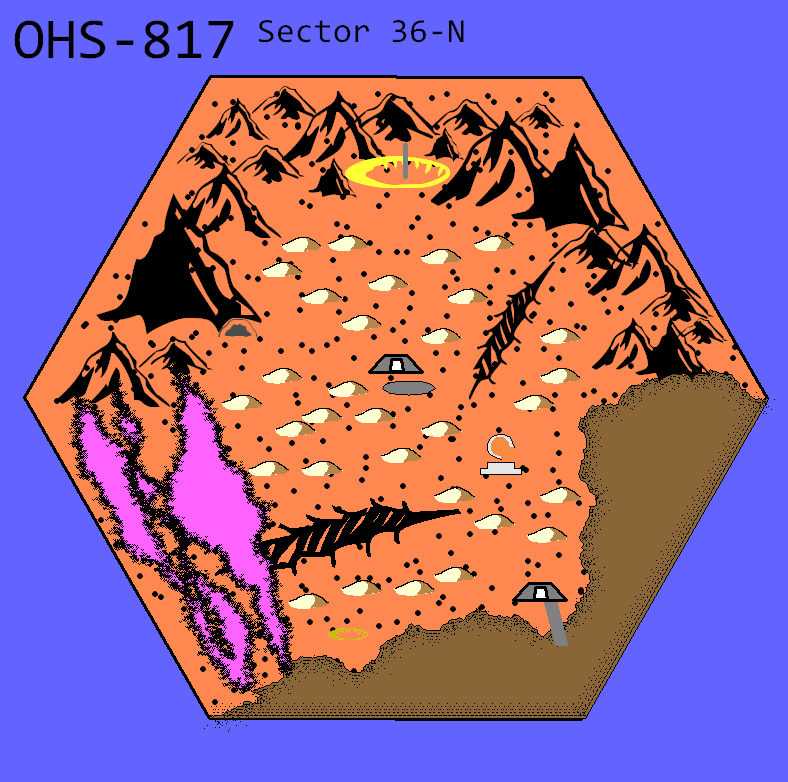
Map


I can hardly think of a better place to get dehydrated and potentially die.

Players' crash-site is as the bottom-left, it's the tan pockmark in the ground. East by northeast is the Water Treatent plant. Then Burning Wheel. Then Landing Zone Then the Drahn caves. And then, at the very top, the Hellhammer crater.

I admit that I was thinking about more of a sandboxy atmosphere- more Fallout style, with players "accidentally" finding places on the transit between two points. But I'm not sure how I feel about that now.

Assuming the Burning Wheel is guarded, there are 4 definite EMPIRE fights- not bad. Plus random encounters, I think we can really expect things to get... interesting. I'll make a few maps for the random encounters- just dunes. And both sides roll to see which compass direction they start on. It's not pretty, but This Is Sunburn!!! (bonus points if you Sparta'd that)

Short, sweet, and to the point. Now I just have to make maps for all 3 bunkers... Ugh. Ugggghhhhhhhhh... I'll probably put them together from a side view, then make the individual rooms. Looks more official, and gives the players an enhanced... depth of what they're getting into. Pardon the pun.

As always, more later. I think I'm not going to change the map from here.

One idea I had for the next campaign is zombies. A little cliched, but I think I can pull it. Especially if it's Jericho style, with a small mid-western town (I'm thinking Arkansas) and a biker gang. And an angry black woman, coming to grips with her identity. Oh yes. Lorraine lives.

October 14, 2012

Hellhammer and boredom

Lately I had a thought- Project Sunburn is boring.

-Crash
-Desert
-EMPIRE
-Desert
-Drahn
-Desert
-EMPIRE bunker
-Desert
-Burning Wheel
-Desert
-Hellhammer
-Desert
-End

I was thinking that Mr. X had such a nuance about it, and a certain immediacy. Normally I shun the real world in RPs, but I see what makes it so compelling- it could be happening right now.

The timeline of anything modern inserts it closer to the players' real lives, and is much easier to immerse in. Everyone could be your next-door neighbor. Every location is real. All factions present can be found on the globe. So why is Sunburn so boring now?

I guess the idea of being stuck in a desert just isn't that appealing. Just walking around, getting dehydrated, sounds mundane. We want action. Waah. The random encounters help, but there's not much avoiding it.

I plan on having random encounters, and-

Oh fsck it. I'm still hung up about the A[name removed] thing. Also pissed at being punched in the arm instead of told, "hey asshole, you screwed up!" Actions speak louder than words, but my hearing is fine. Now I know to not fsck around with trains, or to immolate people, or to make mention that no body was found. Cool. Awesome. A didn't seem pissed at me, but I'd believe that she's good at smiling and staying quiet. I'd expect her to go on a self-righteous rant, but maybe this goes deeper. Hell if I know. Fuel-air bomb has been replaced by a sniper attack.

Anyhow, I'm thinking about that action curve from Star Wars. Lemme drag it up.


This is what I'm trying to get. I figure the desert wandering takes up the low spots, with the higher ones being any EMPIRE bunker, Burning Wheel, ending with Hellhammer. I'm just feeling all out of sorts at the moment.

Still hung up about A. I feel super bad for just ripping a hole to a really bad emotional spot. And I justified it like a dolt.

"Yes, J, bad things happen in RPs. People die. Some are horribly maimed. I imagine people dying, and you gladly participate."

What a douche thing to say.

Hellhammer is a giant robot. It's been built from the head down, and the players find it built to the pelvis. It's surrounded by gantries, and is loaded with weapons (like automatic grenade launchers). They flip it over by adjusting the jacks (to raise it up for construction), then bury it under something. Either fuel or toxic stuff. I'll give them a choice. Fire damage or poison.

It can turn to face north, south, east, or west. There's a computer terminal at each corner (NW, SE, etc), required to authorize the lifts. The piece of the Burning Wheel is used to power it, or something. Probably a processor, makes sense for advanced alien tech.

Alright, done with that brain dump. Going to go whip myself a couple of times.

October 11, 2012

Gameplay of Project Sunburn

It would be all too easy for Project Sunburn to be a 3-dungeon crawl. The players arm up by killing patrols, and looting their stuff. Then, when they have enough bullets and medkits, rush one of the EMPIRE facilities. Maybe bump into the mythos of the Hellhammer by accident. It would be so easy to run this game like regular D&D.

But it's not D&D- it's supposed to be harsh and "survival oriented," and "difficult." The patrols have at most 20 bullets per person, and less than two canteens of water. Everyone is supposed to feel the pinch.

PS is very highly modeled after Hunter Prey. The idea of being stranded on a desert planet- I mean, come on guys... OHS-817. Read it in 1337- is a horrible thing to fathom, especially if there is a literal EMPIRE who destroys gods for weapons research.

So what is the gameplay?

There must be wandering. Fallout-style random encounters with Drahn, EMPIRE, twisters, and other random crap would bring more life to an otherwise gameplay-dry desert. Maybe they find a missing piece of Hellhammer out there.

I want 3 EMPIRE bases in the desert- Hellhammer site, and 2 outposts. The map is going to have geography in such a way as to isolate the final encounter, perhaps in a mountain range defended by twisters. Now, just the light-weight twisties. I'm not evil enough to put down the full-bore pick-you-up-and-maim-you ones.

I'll be thinking about it for the rest of the day. I'd like to cite Chrono Trigger's gameplay as inspiration- find local legends, then find them out there. With an emphasis on exploration and water scavenging.

For an example, I've been considering a tornado pit. A track shaped like a ring, with a big twister in it. And at the very center is something magical. Most likely the Burning Wheel itself, because that's just epic. More thoughts on this later.

September 30, 2012

Project Sunburn rough draft

Project Sunburn is an homage to the following movies:
  • Hunter Prey
  • Jurassic Park
  • Star Wars, to an extent
  • Six-string Samurai
  • Pitch Black
I should elaborate. Long stretches of perilous survival punctuated by frantic fire-fights with a couple groups of opponents. It is by no means post-apocalyptic. I'm breaking that habit, dammit!

Basic idea is as follows: The players' ship crashed (big surprise) on a desert planet. They need to escape via spaceship. Remember these guys?


They've taken up various forts and bunkers on the surface. I'll need to invent a major population (native). They are the main antagonists- militaristic, efficient, and adapted to the planet. They also drink salt water, just to be a dick to the players (they'll need a purifier).

More details later. For now, I'm trying to establish the main "theme" as well as the atmosphere. I imagine a lot of Rammstein is going to be involved.
So I was thinking today, "I really need a blog so I can remember all of these fantastically amazing thoughts I'm having."

Then I remembered I already have a blog...

Anyhow. More things to come, as well as a lot of field reports. Consider this brain-dump space. Now I'm going to frenzy up a tag-storm.