Sometimes, I'm blown away by small plot devices and sudden realizations. It doesn't help that I've been simmering in early-summer heat all day, and drinking caffeinated soda. I'm a little shaky, and I think it helps.
A good friend of mine was GMing. It was the typical end-of-times fare: Oil is gone, large fissures are dividing the surface of the Earth, and asteroid strikes are a common sighting.
Our characters were: An auto mechanic in California, a Kuwaiti globetrotter with an appreciation for martial arts and spirituality (that's me), and a UN diplomat.
The plot was mainly escaping from natural disasters. California was flooding (thus taking the auto mechanic, Phillip, Eastwards), Kuwait was about to get fissure'd (thus prompting my flight to Geneva), and the UN diplomat was nice and snug in (guess where?) Geneva, Switzerland.
There was an interesting Act 1, even though I don't think it was intended that way. Act 1 was us abandoning hope, and making for higher ground. Philip, the mechanic, started to head east before California flooded. My flight was supposed to get to New York, but I decided Geneva was much more friendly towards people of middle-eastern descent. James (The UN Diplomat) had to work on some paperwork for a large pow-wow to decide the fate of the world, in the only character arc not motivated by self-preservation.
Act 2 (even though the GM doesn't know about the three-act story) was about aliens. Yes, aliens. James had one knock on his door at 4 in the morning, and found out it was a shape-shifter named "He." They talked a bit, then James went to bed.
I met up with them a bit later, as I was walking by his house. He (To tell the name from the pronoun) had taken to looking identical to James, so I was rather confused, but they eventually convinced me to come along and see what the madness was about.
Philip was caught at a road-side barricade in Nevada, and taken to a FEMA camp. 24 hours later, everyone else was killed horribly. The bodies were stripped of flesh, organs, and skin, but were "posed" like they were at the moment of death. He touched a soldier's uniform, and the whole assembly came crumbling down. He scavenged some weapons and supplies, then hit the road again. In his rear-view mirror, he saw something large, bony, and insectoid glaring at him. He waved and drove off.
The end of Act 2 took place at the UN meeting. James and I decided our best bet was to let He tell his side of the story: There was something else, commonly called "The Ravager," but called She in their native language. Simply put, She will eat everything and move on. So, the only way to survive is to hide underground for 300 years (3600 lunar cycles) while She starves to death.
James and I utilized He's abilities as a shape-shifter to get past security, and into the main chamber. James was called upon to give a report, and saw this as his time to put He on a pedestal for the whole world to see.
~
Now, this is where something very interesting happened. The GM had us play the part of various foreign leaders to get He's full situation report. We spent about ten minutes getting familiar with his plan, and this whole part worked out really well. It's definitely something I'll want to use in the future.
The end of this debate was He showing his true form. He's ten feet tall, and bright silver. Security (and the snipers) panicked, and shot him. He is not bulletproof.
Then we realized something. In order to prove that he is an extra-terrestrial organism, he would've revealed his true form at the beginning of the speech, not the end. Thus, we thought, he would've been gunned down before he could bend down to speak into the microphone. Thusly, his speech and plan would never have been delivered. So, James and I were left as the only two people who knew how to survive She.
~
Act 3 is the story of She almost wiping out the entire human race. Unlike He, She has very few physical restrictions. She is nearly indestructible, can teleport, is highly intelligent, and very perceptive (except for finding things underground. Blind spot!). Also, for every kill it makes, it can reproduce.
We started with Philip, who met up with a cousin, and sought refuge in an Army bunker. She had already killed everyone inside and left, so they buried the bodies, closed the hatches, and spent the next two years scarfing down MREs and listening to the radio. It was really sobering, listening to the process of America dying. First, reports come in of aliens, cult killings, and bigfoot sightings. Then the radio stations start going dark, fleeing an "unseen epidemic." In two months, America is silent. In two years, the North American continent is desolate. In two and a half years, they run out of MREs, and can see nothing outside the armored doors. She missed them. Barely.
James and I had a different end. Realizing our chance to shephard humanity into life-saving bunkers was kaput, we left for the mountains of Europe and lived off the land. We had the same result- two months until Scandinavia was empty, two and a half years until the radio couldn't pick up anything.
Our days are spent hunting, trapping, and recording our lives on cave walls with charcoal. We thought about using books for journals, but the paper would erode too quickly.
While on a deer hunt, we noticed the game was spooked by something. We waited to make sure it wasn't a bear, and found nothing. Once we went to skin the game, we were ambushed by a couple of Shes. Instead of killing us outright, however, they grinned as much as their mandibles allowed, then left. Mocking our frail existence, as well as our race.
And, that's where it ended. I later found out it tied into another RP we've been cooking up (basically a Reign of Fire/Mechwarrior mashup), and fit perfectly. But, that's not my main focus.
~
We were all expecting a "good" ending. Either, He delivers a speech to the UN on how to kill these things, or at least coordinates a mass-migration to below the Earth's surface to survive the She-pocalypse. But neither happened. He died, and we were left to survive on our own and watch our planet die away. It was very moving, and shocking on a severe level. No happy endings, just three people who won't see the planet recover. And yet, it was fulfilling. We did it. We stuck it out until the end, and our writings on walls might be remembered and upheld by future generations (what few there will be). Or, they'll be ignored and slandered. At least we tried.
~
He mentioned that every male on their planet is called He. No individuality to speak of. I'm not sure if this is the same She that they reproduce with, or if they just don't know how to classify it. I didn't probe that deeply. What matters is, it was weird, and different enough to portray an alien as something uncomfortable and dissimilar to what we call "human." It actually caught on after a while.
Now, I must retire to bed, and have some really groovy nightmares. Until later.
-Nosnamreh

Showing posts with label RPs. Show all posts
Showing posts with label RPs. Show all posts
July 6, 2013

July 5, 2013
Field Report #1
This is something I've been meaning to do since the very beginning of the blog. One of the most important parts of any craft is self-improvement. And, critical to this process is archivism and memorization. Computers make this much easier.
With that in mind, I recently met up with some siblings and cousins for July 4th to show them what I do as a hobby. It's actually easier to show, rather than tell (and, so should everything else about this work). There were five players- but, I don't totally remember which ones did what exactly, so I'll just mention "a player" if something needs to be mentioned. I suppose in a more detailed and exact setting this would be required, but for now, it's just a fun into to RPing.
The setting was the Office of Applied Telecommunications. The employees of this institution have the training to inhabit someone's consciousness over a telephone line, then "drive" the bodies on the other side. All recipients of this must be consensual, and the native intelligence has the option to regain control at any time. You don't need to remain on the line to drive someone, but it's a nice bail-out option. Aside from this, the characters didn't have (or need) any special characterization. The only non-standard ability they needed was to dial someone up and jump in.
~
I made a pretty weak attempt at an act 1, in the beginning. The players begin in their "office-" a bulletproof enclosure with two armed guards outside, in the bowels of a secure office building. The worst-case scenario for a wire-driver (catchy, I like it) is that someone kills them while they're in someone else's head, so security is a must.
They're called up to see their boss, who has something to tell them. I offered the option to call his secretary, and walk in as her (common practice in the office), but they declined and decided to walk instead. Okay, alright. No worries.
On the way over, there's something on TV: A space shuttle mission to deliver telescope parts to the ISS is under way, in order to examine the incoming "Arkady Cluster," a large asteroid group on a rough path for Earth.
Their boss's artificial leg had broken into several pieces, and he wanted them to relay some information to the archives department. I gave each of them one piece of it, in manageable chunks. This way, they could remember it and recite it completely as someone else.

With that in mind, I recently met up with some siblings and cousins for July 4th to show them what I do as a hobby. It's actually easier to show, rather than tell (and, so should everything else about this work). There were five players- but, I don't totally remember which ones did what exactly, so I'll just mention "a player" if something needs to be mentioned. I suppose in a more detailed and exact setting this would be required, but for now, it's just a fun into to RPing.
The setting was the Office of Applied Telecommunications. The employees of this institution have the training to inhabit someone's consciousness over a telephone line, then "drive" the bodies on the other side. All recipients of this must be consensual, and the native intelligence has the option to regain control at any time. You don't need to remain on the line to drive someone, but it's a nice bail-out option. Aside from this, the characters didn't have (or need) any special characterization. The only non-standard ability they needed was to dial someone up and jump in.
~
I made a pretty weak attempt at an act 1, in the beginning. The players begin in their "office-" a bulletproof enclosure with two armed guards outside, in the bowels of a secure office building. The worst-case scenario for a wire-driver (catchy, I like it) is that someone kills them while they're in someone else's head, so security is a must.
They're called up to see their boss, who has something to tell them. I offered the option to call his secretary, and walk in as her (common practice in the office), but they declined and decided to walk instead. Okay, alright. No worries.
On the way over, there's something on TV: A space shuttle mission to deliver telescope parts to the ISS is under way, in order to examine the incoming "Arkady Cluster," a large asteroid group on a rough path for Earth.
Their boss's artificial leg had broken into several pieces, and he wanted them to relay some information to the archives department. I gave each of them one piece of it, in manageable chunks. This way, they could remember it and recite it completely as someone else.
- It's called Project EverReady- a syringe four inches long, designed to improve soldier nutrition and endurance during night-time operations.
- There was a problem. Early symptoms were yellow eyes, decreased motor functionality, and other symptoms indicative of Malaria.
- Mid-way symptoms were hallucinations, babbling, no physical ability, and moderate psychosis.
- Late-stage symptoms were an inability to communicate, extreme hostility, and cannibalism.
- The situation was resolved with several airstrikes, JDAM bombs, and the national guard sweeping the area.
The players asked why he didn't take the information over himself, or send an email. His answers (AKA my answers) were that IT is having problems, and his leg is going to take a while to put together. We went back and forth for a bit on this. The players recognized it as me railroading them, and decided to just go with it.
Either they walked to archives, or made a conference call (five players jumping inside one person's head). Either way, they met someone in archives named "Kingston." They relayed the information (quick version? Zombies. They're dead now.), and Kingston mentioned he's sorry for the inconvenience, seeing as they're reserved for the day.
... Wait, what?
It's really sketchy to be "reserved" in this job. Most of the time, you get a call, and jump in. So, that's a little black-ops.
Kingston went back to his filing work after they finished talking, and the players head back down to their office. Act 1 complete. This whole section was supposed to be an intro to the everyday life of a wire-driver, and it partially succeeded, even if I kind ham-handed it.
~ Popcorn break ~
In their office, the players get their assignment. NASA is having some trouble, and they need some wire-drivers. There's five phone numbers in the file, to five "liasons" (People who's job is to get driven around) at the NASA office.
They arrive in NASA, as expected. All the people they arrive at have lanyards, which identify they are being driven, and they're not the actual employee you see before you. In just the other room, they find a man in his late 40's drinking coffee. He introduces himself as Ken, one of the NASA supervisors for the mission. There's a window that looks over this room:
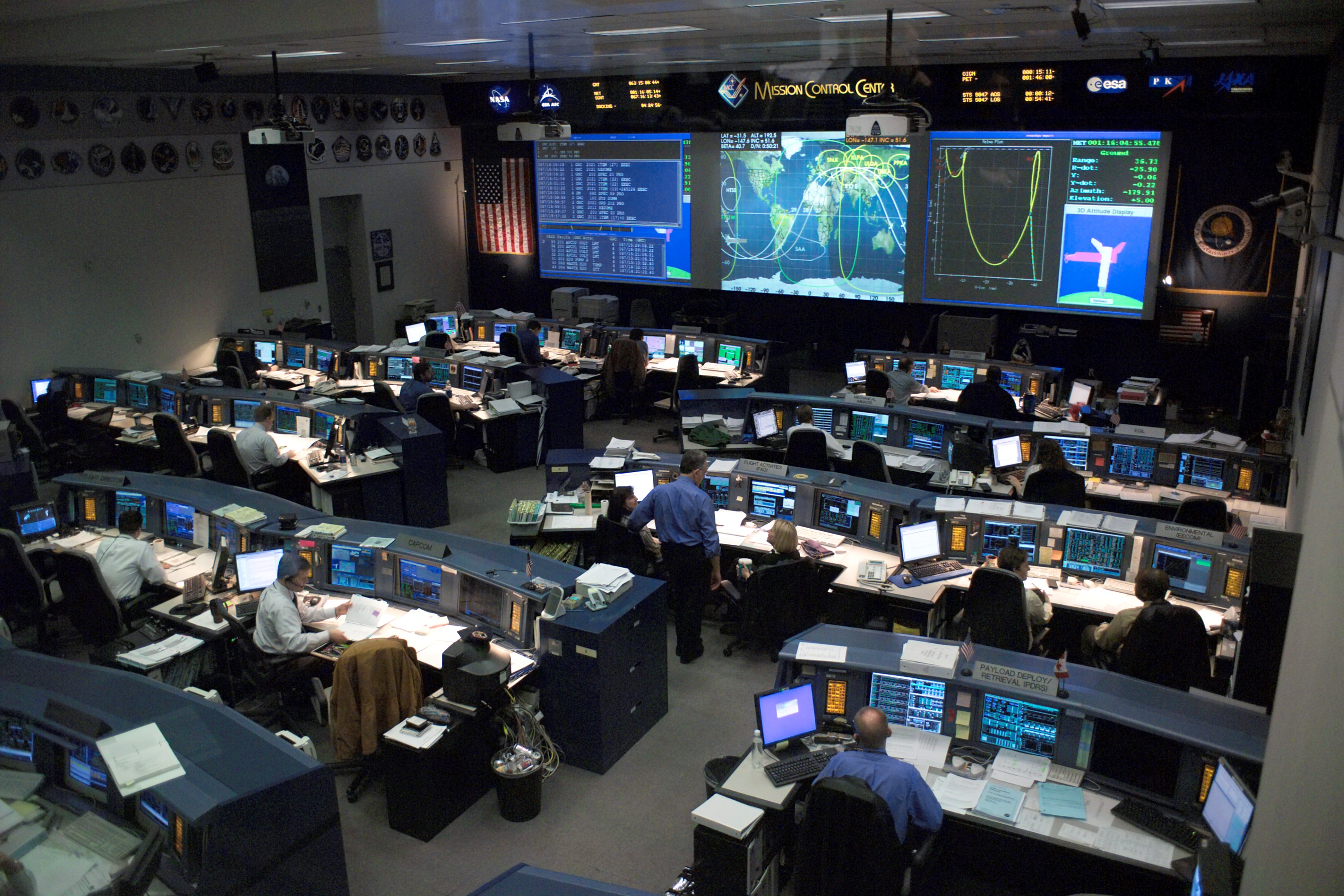
And it looks like people are panicking. Ken gives the following brief: Six astronauts went up in the shuttle, and five are now comatose. The one who's still active is an Air Force sergeant named "Simms." Simms lost communication about six hours ago, and they need to stabilize the situation. They want the wire-drivers to get into the astronaut's heads (via headsets they're wearing), see if the bodies are usable, then make sure Simms stays alive. He mentioned there was a possible fire hazard on board.
There's another thing, too. NASA wants Simms to know he has clearance for something called "B Tube," now that the mission has gone as bad as it has. Ken doesn't know what B Tube is, but it's in Simms hands now, once he finds out.
The players are immediately suspicious, and want to know what it is before they tell Simms to go for it. They ask Ken to direct them to his boss, Albrecht. "He's got a clear door with a dry plant next to it." He takes them gladly, and two players decide to take off the lanyards indicating they're being driven. Ken raises and eyebrow but doesn't say anything.
Albrecht is busy in his office, sending emails, crunching numbers, and being executive-like. He may even have a drop of sweat on his forehead. "You're the guys from Telecom?" He asks, seeing Ken's people. Both of the "hidden" players mention two of the wire-drivers aren't in yet, and they're just keeping up with the crowd. Albrecht doesn't catch on to the ruse, and just mentions "Alright. I don't understand how your office works, do what you have to." After grilling him for a bit about B Tube, he doesn't really know what it is. "Something to help the astronauts up there, I'd assume. My boss gave it to me."
The players are getting pretty suspicious by this point. But, as Ken points out, there's a lone guy on the shuttle who's in desperate need of some help. The players go along with it, head back to the room they came from, and dial the astronaut's phone numbers.
In orbit, the bodies are really nice. They're fit, they're in good condition, they look pretty good, but there isn't a consciousness. It's like they're in a coma. Typically, the host consciousness has a presence in the mind- it can point things out, talk to the driver, and explain the significance of certain people or objects. No such thing here. There is another presence in the mind, but it doesn't have any activity. Somewhat like jacking someone while they're asleep.
They were tied to the "beds" on the shuttle, and the buckles are easily undone. They can hear activity in an adjacent section, so they call out. Simms pokes his head in.
Simms is highly sleep-deprived. He's got bags under his eyes, and he's a little bit bloodshot. A lot of the electronics have been opened up and examined as he tries to troubleshoot the radio problem.
The players agreed, ahead of time, they're not going to tell him he has "B Tube" clearance. But, they will ask him.
His story is as follows: Everything started fine. Ignition, launch, tin can in a tornado. But, about an hour and a half in, the rest of the crew started to show signs of sleep deprivation- lowered cognitive ability, clumsy, sleepy. He hit himself up with an adrenaline stick, and send the most tired ones to quarters first. Ten minutes later, he was the only one who was still awake. "And, funny thing is, they rushed me through the program. Thank goodness I'm a pilot, or we'd really be shafted." he tied everyone to their bunks, and has been maintaining a steady orbit since.
When asked about B Tube, he mentioned "I dunno. I think it's a defibrillator of some kind." He's not awake enough to be suspicious, so they keep going. On the way to the broken radio, the players notice a large metal container in the cargo bay. "The replacements for the ISS," he mentions. He shows them the radio, and says he's been asking the computer to help him troubleshoot, but he's been getting nowhere. "Did you meet someone named Ken? You did? Well, he probably knows what to do. Please, get down there, and ask him what I should do. No comms is a really bad way to fly up here."
At this point, the players make a game-plan. Two of them will head back to see Ken, and work the radio problem. Two more will stick around with Simms, and learn as much as they can about space shuttle 101 in case he needs to crash from sleep deprivation. Yet another one is going to get a closer look at the chest (discreetly), then rejoin the others.
The chest had some of the following specifications:
- This chest rated up to 22000 PSI impact hardness
- Rated for 3 days of gamma radiation exposure
- This container does not contain supernatural or paranormal entities
- Certified by Arnhardt metallurgy and munitions company
There were a few others, but I remember these ones. The player who examined it mentioned, "Okay, we have a plan B. Put Simms in the box and shove it to Earth."
We laughed a bit, and I remembered I'd ham-handed it once again. The chest has hinges as big around as my forearm, and was welded, bolted, and strapped to the floor. No way in hell it's going anywhere.
A transmission from Earth triggered a cold-war communication device. Remember that thing from Doctor Strangelove, that pops up the letters and numbers that you look at in a code book? One of those. The message was, "communication established." But, the radios were still out. So, Simms theorized it was a burst transmission that would let the players beam around some more, but not enough to establish radio. Yeah, direct plot device for convenience. Sue me.
Another notebook had information about B Tube. It was referenced in the index, then on a sticky note on the appropriate page.
"When the time comes, open the chest, pull the small case out, and follow your training. -Albrecht"
In the meantime, Ken saw to the radio problem as best as he could. The computer was taking a while, so he struck up a conversation. "After being in the program for as long as I have, everything becomes so dependable. For example, I can promise you that all of those astronauts have 72 vaccinations before launch. Go ahead, look it up."
It took some addition goading, but the players opened up the personnel files and looked at it. 72, 72, 72, 73, 72, 72. "This one has 73."
Ken grinned and chuckled. "Ha ha, guys. Funny."
"No, really. Take a look."
[drops coffee] "Say what!?"
Simms had an additional one, as it turns out. The plot thickens. Ken calls one of his buddies down in medical, and relays the name of the vaccine. It's not recognized by the system as existing.
~
And, that's where we had to cut it off. It was fun, and the siblings and cousins look forward to finishing it. We'll Skype it some time. I'm going to be doing this with my usual Saturday group, so that should be cool.
One thing that impressed me was the depth the players went to. They asked questions, second-guessed things, and generally acted like normal people would in that situation. Part of this, I attribute to them being new players to this thing. We did it a few times in our youth, but it's been a long time since then.
A new player doesn't understand the "norms" of this activity. For example, most of them didn't know if their death was a possible ending (it's not. The story is designed for success). But, being totally new in the world, they had a more real response to the things around them. It also helped that they don't know my GMing style- what's important, what's not. They looked deeply into everything, made group decisions, and went about it very carefully. Excellent!
This is a pretty sizable report, compared to what I was expecting. Not that I mind. I look forward to making more in the future, especially once the EE gets kicking. Until then, stay cool.
April 19, 2013
Powerful Imagery Redux
I think I've finally figured out what I was trying to say last post. Bear with me here.
Powerful imagery is any moment where the players stop, and really appreciate their surroundings. Either in a positive, or negative way.
I cite Halo:CE as my first real experience with this. After finishing the game, and going back to the menu, I watched the ring float silently in space amid a timeless, seemingly omniscient choir. Ever since that moment, I've always appreciated the spectacle involved. Looking at it now, I'm filled with a mix of emotions- fear of what's down there, happiness for my own survival, and awe for the creation of such an advanced structure.
The elements all blend together perfectly.

Powerful imagery is any moment where the players stop, and really appreciate their surroundings. Either in a positive, or negative way.
I cite Halo:CE as my first real experience with this. After finishing the game, and going back to the menu, I watched the ring float silently in space amid a timeless, seemingly omniscient choir. Ever since that moment, I've always appreciated the spectacle involved. Looking at it now, I'm filled with a mix of emotions- fear of what's down there, happiness for my own survival, and awe for the creation of such an advanced structure.
The elements all blend together perfectly.
Of course, the effect is diminished once you actually play the game- it's hard to appreciate the scenery when you've only got 5 minutes to get the hell out of dodge. This is where the developers show another masterful touch: There's one or two "wow" moments in each level.
One thing virtually every medium has is its own "wow" moments. Video games, RPGs, movies, paintings, music, dance, etc. All can express it somehow. In music, it's the best part of the song. In movies, it's usually the climactic turning point (In Independence Day, it was the White House getting lase'd by an alien ship).
RPGs make it a little more difficult, because the only input the players have is what the GM says and does. If there's something truly powerful, he/she/it has to describe it in detail, in such a way that it's powerful.
"You see, like, a mountain range in front of you. The sun is shining on it, and stuff. There's a couple eagles too."
Though difficult, I endeavor to put in a few instances of powerful imagery in the large-scale RPGs I do. Sunburn has two (very beginning and very end), and the planned Spectrum RPG will have at least five. The purpose is to give the players a sense of accomplishment, and to let them relax in a way (only the positive ones).
One that I have planned is a tribal ceremony on top of a local mountain. Having been accepted by the people, the council of elders decide to officially induct the player characters into the tribe. It's a night of torches, dancing, alcohol, and tattoos. During this moment, I'm not going to have any rolls for the players to make. It's a relaxing, festive moment designed to showcase more of the tribals, and make the players feel welcomed in a foreign land.
A consequence comes with the use of powerful imagery- overuse. If too much spectacle and attention is brought to every facet of the game, it just waters down the experience. When everything is special- nothing is. It becomes the new bland. This is why I deliberately limit myself to only a handful of moments- to keep it amazing when it happens.
It's a powerful tool. As with any tool, there are good ways to use it and bad ways to use it. And, as long as I'm a little better each time I use it, I'm okay.
April 12, 2013
The Ideal GM
A while ago I did a post- the ideal tabletop gamer. Today I wanted to expand on it in a simple way.
The ideal GM should also be a good player.
There's numerous quotes about leadership, but the one that comes to my simplistic mind is; "Those that cannot follow, cannot lead." That sounds very sadistic on paper, but it's true. The player's role is to follow the narrative, and enjoy themselves along the way. The GM's job is to make the narrative and respond to any player feedback. And to enjoy him/her/itself.
One thing I truly appreciate is dedicated players. People who can just follow a story, wherever it goes. There's something magical about it- being able to deliver an experience perfectly, to an eager audience. I'm mostly sure that's one of my basic food groups by now.
The internet (and local chatter) is stuffed with stories of bad GMs. Ninety percent of those shortcomings could have been avoided if the GM would have thought, "How would I like this as a player?"
Some food for thought.
The desert is an oasis of blood.
The ideal GM should also be a good player.
There's numerous quotes about leadership, but the one that comes to my simplistic mind is; "Those that cannot follow, cannot lead." That sounds very sadistic on paper, but it's true. The player's role is to follow the narrative, and enjoy themselves along the way. The GM's job is to make the narrative and respond to any player feedback. And to enjoy him/her/itself.
One thing I truly appreciate is dedicated players. People who can just follow a story, wherever it goes. There's something magical about it- being able to deliver an experience perfectly, to an eager audience. I'm mostly sure that's one of my basic food groups by now.
The internet (and local chatter) is stuffed with stories of bad GMs. Ninety percent of those shortcomings could have been avoided if the GM would have thought, "How would I like this as a player?"
Some food for thought.
The desert is an oasis of blood.
April 3, 2013
Finishing Sunburn - 2/5
Gah, procrastinated Tuesday. Dammit!
Today (Wednesday), I'll be adding enemy populations and making sure the EE isn't totally broken. Probably some character creation for the Thursday and Friday play-through.
~
One idea I had was for player characters to have manifest destinies. The session before the end, I'll have them write up what they want to happen to their characters. So, I can jury-rig the plot of the campaign to put them in those positions, respectively.
I'm pretty sure Grognardia actually inspired this one. The idea being that after they hit epic level... well, it's no more fun, because the PCs are nearly god-like in power. But, the actual idea was that the characters retire, and inhabit the world they've helped change.
I thought it would be a good touch for players (most likely at the end of Spectrum) to be able to retire their characters. Now, not necessarily retire like we do, but have a "manifest destiny" of sorts. Most likely settling, or wandering any of the worlds made available to them. This idea is still rolling around in my head, so it'll take a while to perfect. I just thought it was a cool idea- and isn't that what really matters?
Today (Wednesday), I'll be adding enemy populations and making sure the EE isn't totally broken. Probably some character creation for the Thursday and Friday play-through.
~
One idea I had was for player characters to have manifest destinies. The session before the end, I'll have them write up what they want to happen to their characters. So, I can jury-rig the plot of the campaign to put them in those positions, respectively.
I'm pretty sure Grognardia actually inspired this one. The idea being that after they hit epic level... well, it's no more fun, because the PCs are nearly god-like in power. But, the actual idea was that the characters retire, and inhabit the world they've helped change.
I thought it would be a good touch for players (most likely at the end of Spectrum) to be able to retire their characters. Now, not necessarily retire like we do, but have a "manifest destiny" of sorts. Most likely settling, or wandering any of the worlds made available to them. This idea is still rolling around in my head, so it'll take a while to perfect. I just thought it was a cool idea- and isn't that what really matters?
February 19, 2013
My design strategy
Something simple this time. I thought about putting it in Bite-sized thoughts 3, but I want this to be a little more visible.
If you take a story (fiction, of course) and break it down to its most basic form, it's ridiculous.
If you take a story (fiction, of course) and break it down to its most basic form, it's ridiculous.
- A midget and his friends must destroy the most evil piece of jewelry in the world
- Four kids enter a wardrobe, trip balls, and see a lion
Some liberties may have been taken in these summaries.
This effect can be reversed. Start with something completely ridiculous, then play it straight-faced. I'm not going to toot my own horn on this one, instead I'm going to let you look at what I've posted and theorized, and let you make up your own opinions.
Things will start to get really weird once I get into the Spectrum RPG. Until then, Sunburn shows this design philosophy slightly.
February 12, 2013
Talking Heads
Something a little different this time.
One of the hardest parts I have with GMing is keeping characters distinctive. To remedy this, I had the idea to use something like flash cards.


With just a glance, you could look down and get a rough idea of how to act out each character. The pictures are mainly just for quick identification.
The words are there to bring up the most likely tone of response. GUIDE is encouraging by default, but occasionally lapses into history, being very well educated. If the players elicit a further response, GUIDE's vulnerable side bleeds through.
The cards can't tell a complete story. I knew from the get-go that GUIDE is afraid of dying, even though it's artificial. That's mainly just there as a reminder. If possible, the response will be historical/factual, or encouraging in any way. GUIDE's a good guy.
Mister Fixer is a different story. He's a tough guy, who drives muscle cars and lifts weights. His day job is assassination, something he doesn't hide. If he can't think of a "tough" thing to add to a conversation, he'll tell a little story about his line of work. And, at the very core, his dirty secret- he's a proud father. This adds a little bit of character depth, and as the players get to know him more, he'll probably open up about it. Probably. Maybe. Possibly.
The quotes at the bottom are just a little phrase to help identify the speaker. I plan to have it show up at least once in every conversation, to reinforce the character. Obviously, the phrase is kept as open as possible to let it be spliced into any part of speech.
One of the hardest parts I have with GMing is keeping characters distinctive. To remedy this, I had the idea to use something like flash cards.


With just a glance, you could look down and get a rough idea of how to act out each character. The pictures are mainly just for quick identification.
The words are there to bring up the most likely tone of response. GUIDE is encouraging by default, but occasionally lapses into history, being very well educated. If the players elicit a further response, GUIDE's vulnerable side bleeds through.
The cards can't tell a complete story. I knew from the get-go that GUIDE is afraid of dying, even though it's artificial. That's mainly just there as a reminder. If possible, the response will be historical/factual, or encouraging in any way. GUIDE's a good guy.
Mister Fixer is a different story. He's a tough guy, who drives muscle cars and lifts weights. His day job is assassination, something he doesn't hide. If he can't think of a "tough" thing to add to a conversation, he'll tell a little story about his line of work. And, at the very core, his dirty secret- he's a proud father. This adds a little bit of character depth, and as the players get to know him more, he'll probably open up about it. Probably. Maybe. Possibly.
The quotes at the bottom are just a little phrase to help identify the speaker. I plan to have it show up at least once in every conversation, to reinforce the character. Obviously, the phrase is kept as open as possible to let it be spliced into any part of speech.
- MF (see what I did there? =D) Blows up a car: Too easy.
- During a set-up: Anyone else think this is a little too easy?
- Talking about cars: ... Makes it too easy. A child could do it.
It's just a GM aid, ultimately. I have no guarantee this will improve anyone's ability, or concentration. In fact, it might be too distracting. I'll have to find out myself.
But, if it helps, go for it!
January 31, 2013
Symbolism, tone
I'm going to stop talking about story eventually. It will be glorious, and probably involve bunker maps.
The overarching theme, as well as tone, are essential to any RPG. There's dirty and gritty ones, high-minded ones, perfectionist ones, crazy ones, etc. It's a bit harder to express due to the nature of the GM acting as interpreter for the game, but it's still there. Let's trace the theme of Sunburn backwards:
The EMPIRE are a bunch of potato people, grown in vats, computer-chipped, then given guns to accomplish whatever task their masters wish.
The TLA are the standard human sci-fi affair, with spaceships and power armor and whatnot. There's also a pun in there.
By putting the players between a rock, a hard place, and two opposing, faceless empires, the focus is all on surviving the planet, as well as figuring out just what the hell is going on. I could have just as easily drummed up names for either side, but that defeats the purpose. Sunburn isn't about politics, it's about survival. It's much more earthy and grimy than, say, Star Wars. It doesn't matter whose flag you have on your back- there's people shooting at you, and they have their own flag!
~ Intermission ~
The tone of Sunburn is vaguely inspired by Samurai Jack. And Fallout. Everything here comes back to Fallout, somehow.
Most of the game is spent walking in the desert, taking in the beauty of it. An appreciation for nature is supposed to come of this, and eventually compel the players to make a decision completely opposite of the one they made when they come to the surface. It's about finding beauty, and coming to peace with a harsh situation.
This is punctuated by moments of intense combat, and close-quarters encounters with EMPIRE troopers. Not just for dramatic contrast, but also for plot, item mechanics, and to break up the long travels. Also a good chance to get all your ass-kicking done in one place.
This is one thing that so many games miss the boat on- have a theme, as well as a tone. It's not enough to have something which has an immediate draw- give it some staying power, and a style of its own. Otherwise, you're just making Call of Duty. I'd much rather make Sunburn than CoD.
The overarching theme, as well as tone, are essential to any RPG. There's dirty and gritty ones, high-minded ones, perfectionist ones, crazy ones, etc. It's a bit harder to express due to the nature of the GM acting as interpreter for the game, but it's still there. Let's trace the theme of Sunburn backwards:
The EMPIRE are a bunch of potato people, grown in vats, computer-chipped, then given guns to accomplish whatever task their masters wish.
The TLA are the standard human sci-fi affair, with spaceships and power armor and whatnot. There's also a pun in there.
By putting the players between a rock, a hard place, and two opposing, faceless empires, the focus is all on surviving the planet, as well as figuring out just what the hell is going on. I could have just as easily drummed up names for either side, but that defeats the purpose. Sunburn isn't about politics, it's about survival. It's much more earthy and grimy than, say, Star Wars. It doesn't matter whose flag you have on your back- there's people shooting at you, and they have their own flag!
~ Intermission ~
The tone of Sunburn is vaguely inspired by Samurai Jack. And Fallout. Everything here comes back to Fallout, somehow.
Most of the game is spent walking in the desert, taking in the beauty of it. An appreciation for nature is supposed to come of this, and eventually compel the players to make a decision completely opposite of the one they made when they come to the surface. It's about finding beauty, and coming to peace with a harsh situation.
This is punctuated by moments of intense combat, and close-quarters encounters with EMPIRE troopers. Not just for dramatic contrast, but also for plot, item mechanics, and to break up the long travels. Also a good chance to get all your ass-kicking done in one place.
This is one thing that so many games miss the boat on- have a theme, as well as a tone. It's not enough to have something which has an immediate draw- give it some staying power, and a style of its own. Otherwise, you're just making Call of Duty. I'd much rather make Sunburn than CoD.
January 27, 2013
The ideal Tabletop-Gamer
This one's really opinionated. It represents my views as of now, and is not an absolute truth. It's just what I think is best at the moment.
We game for escapism. Everyone does. It's why we watch TV, play video games, and go to art galleries. Escapism isn't necessarily pretending you're an elf in space, but just NOT being who you are every day of the week.
Mark Hermanson is a good guy to be, but sometimes I want to be someone else. Watch the movie "Darkon," they've got some good quotes on this one.
So, my first suggestion for an ideal player is someone who wants to escape from real life for a little bit. Look for the quiet ones who wear dark colors. Someone who doesn't fit in, and really doesn't want to. The outcasts, loners, and social pariahs that our world creates have some of the most amazing things in their heads.
Gaming is storytelling. The best players (doubly so, the best GMs) are the ones who want to make a convincing narrative that everyone can enjoy. The game is secondary, but still a very strong factor. For this reason, people with Roleplaying experience (and not just from team-building exercises at work) are some of the best gamers.
Similarly, players with experience in creative writing, movie and literary appreciation, or even a thoughtful video gamer are also good candidates. Someone who can understand story, and have an awareness of the devices surrounding them, will mesh incredibly smoothly with a good group. Problem-solvers usually aren't good, because Gaming isn't about finishing the game- it's about playing it.
The journey is more important than the destination... but the destination is still pretty awesome.
Creative, enthusiastic minds are the best for creative characters. Even if the character is really boring, the player should be able to make them into a compelling piece of the narrative. This one I'd put as less important, because compelling stories still happen around otherwise bland characters, especially if the players catch on.
These are some loose thoughts, accumulated over the last couple of weeks. I was considering putting this in Bite-sized thoughts 2, but it's a little big for that.
Recap:
And, in the end, that's really all that matters: having a positive experience.
We game for escapism. Everyone does. It's why we watch TV, play video games, and go to art galleries. Escapism isn't necessarily pretending you're an elf in space, but just NOT being who you are every day of the week.
Mark Hermanson is a good guy to be, but sometimes I want to be someone else. Watch the movie "Darkon," they've got some good quotes on this one.
So, my first suggestion for an ideal player is someone who wants to escape from real life for a little bit. Look for the quiet ones who wear dark colors. Someone who doesn't fit in, and really doesn't want to. The outcasts, loners, and social pariahs that our world creates have some of the most amazing things in their heads.
Gaming is storytelling. The best players (doubly so, the best GMs) are the ones who want to make a convincing narrative that everyone can enjoy. The game is secondary, but still a very strong factor. For this reason, people with Roleplaying experience (and not just from team-building exercises at work) are some of the best gamers.
Similarly, players with experience in creative writing, movie and literary appreciation, or even a thoughtful video gamer are also good candidates. Someone who can understand story, and have an awareness of the devices surrounding them, will mesh incredibly smoothly with a good group. Problem-solvers usually aren't good, because Gaming isn't about finishing the game- it's about playing it.
The journey is more important than the destination... but the destination is still pretty awesome.
Creative, enthusiastic minds are the best for creative characters. Even if the character is really boring, the player should be able to make them into a compelling piece of the narrative. This one I'd put as less important, because compelling stories still happen around otherwise bland characters, especially if the players catch on.
These are some loose thoughts, accumulated over the last couple of weeks. I was considering putting this in Bite-sized thoughts 2, but it's a little big for that.
Recap:
- A desire to escape reality for a few hours
- Previous experience as a role-player
- A basic understanding of narrative mechanics and storytelling
- Patience to be in the game, and enjoy the experience, rather than trying to finish it
- Creativity to lend vibrancy and compelling personalities to characters
And, in the end, that's really all that matters: having a positive experience.
Flexibility and shotguns
Here's a little snippet from an RP I was doing last night, and I think a good example of flexibility.
The situation:
An investigator for the DoD (The story arc revolved around missing nuclear warheads) and a geologist (no relation, just a fun character) are going to the den of the town's local biker gang. They've been invited, with the promise of extra information in a seemingly impossible case. They know the bikers (The Flames) are involved, just not how much.
Once they arrive, they meet with the spiritual leader of the Flames, who just goes by Callahan. He runs his mouth for a little bit, then tells them he won't trust them until they do something for him- take a shotgun to the head of a crazy guy in the back room. Eric has been overtaken by Callahan's fiery oratory, and believes that he can only realize his full potential by "leaving this meat-sack of a body." Callahan thinks he's a lost cause, and want the players to mercy-kill him,"the way a true human would."
Callahan's a crazy, superstitious bastard.
The setup:
It's a test. The shotgun is loaded with a blank (the players never checked it), and Eric isn't actually crazy. What Eric is trying to do is goad the players into shooting him by acting wretched, depressed, and over eager for death. Callahan figures if the players actually shoot, it means they're willing to do "what's right," thus letting him trust them.
The complication:
Neither of the players wanted to kill Eric. The DoD agent already has too many ghosts, and can't justify killing to solve the case. The geologist has roughly the same reason, and is more interested in putting Eric through therapy.
As a last-ditch effort, Eric started to beg them to just bring the shotgun in, and let him do it himself. he offered the geologist some information she'd been looking for, in exchange for his own immortality (boom).
I admit, I did expect the players to eventually shoot Eric. I played him as hard as I could, and tried to get them into the idea of mercy-killing him. Wouldn't take. A bad GM would have tried to force the issue further, but I adapted.
The players were quite clever- they suggested Eric stay alive, so he can gather as much worldly information as possible while he's still human, and operating on a human level. Having no counter-point, I worked a solution.
The solution:
After about fifteen minutes (real life) of bullshit philosophy versus merciful intentions, Eric leaned against the wall, and checked his watch. "Good job, you passed. Shotgun shell is a blank, by the way." He mostly looked smug with himself, delivered some dialogue in a sane manner, and gave the geologist the information she wanted anyway.
They went to Callahan for their information, and he gave them this basic spiel: By choosing to reason with Eric, and keep him alive, they proved they're better than the average person, who would have just shot him. This dedication to human life (as well as some really good arguments) tells him they can be trusted as "real" humans, so he gives them the information.
But, he only does it after they promise him (as humans) that what happened in the building, stays in the building. He gives them everything they need to know, and his goons even hold the door open for them.
The icing on the cake:
On the drive back to town, the DoD agent remarked that Callahan is a complete asshole, and the whole thing was incredibly douche-baggy. Mission accomplished.
More thoughts:
This situation was designed to increase tension, and test player's morality. What are they willing to do to recover two (decommissioned) nuclear warheads? Will they kill in something other than self-defense?
If I was a really good GM, I might have been able to play Eric hard enough to get them to shoot him. But, I'm not perfect. So, I adapted. After the first three minutes of conversation, I was 90% sure they wouldn't kill him, so I was partially stalling for time. I had to figure out a good reason for Callahan to pass them for not killing. So, convenient character excuse: Make up some pseudo-religious crap, and keep going.
The message I'm trying to get across is: Be ready to adapt. If I'd railroaded them into shooting Eric, that wouldn't have been any fun whatsoever. But, I need to give Callahan a good reason for trusting them. I suppose I could have just had him remark that "life is sacred, and we should preserve what we can," but that's really unlike him. He's got more fire in his blood than that.
A good GM can react to just about anything and keep the story going- a great GM can make it look like that was part of the plan the whole time.
The situation:
An investigator for the DoD (The story arc revolved around missing nuclear warheads) and a geologist (no relation, just a fun character) are going to the den of the town's local biker gang. They've been invited, with the promise of extra information in a seemingly impossible case. They know the bikers (The Flames) are involved, just not how much.
Once they arrive, they meet with the spiritual leader of the Flames, who just goes by Callahan. He runs his mouth for a little bit, then tells them he won't trust them until they do something for him- take a shotgun to the head of a crazy guy in the back room. Eric has been overtaken by Callahan's fiery oratory, and believes that he can only realize his full potential by "leaving this meat-sack of a body." Callahan thinks he's a lost cause, and want the players to mercy-kill him,"the way a true human would."
Callahan's a crazy, superstitious bastard.
The setup:
It's a test. The shotgun is loaded with a blank (the players never checked it), and Eric isn't actually crazy. What Eric is trying to do is goad the players into shooting him by acting wretched, depressed, and over eager for death. Callahan figures if the players actually shoot, it means they're willing to do "what's right," thus letting him trust them.
The complication:
Neither of the players wanted to kill Eric. The DoD agent already has too many ghosts, and can't justify killing to solve the case. The geologist has roughly the same reason, and is more interested in putting Eric through therapy.
As a last-ditch effort, Eric started to beg them to just bring the shotgun in, and let him do it himself. he offered the geologist some information she'd been looking for, in exchange for his own immortality (boom).
I admit, I did expect the players to eventually shoot Eric. I played him as hard as I could, and tried to get them into the idea of mercy-killing him. Wouldn't take. A bad GM would have tried to force the issue further, but I adapted.
The players were quite clever- they suggested Eric stay alive, so he can gather as much worldly information as possible while he's still human, and operating on a human level. Having no counter-point, I worked a solution.
The solution:
After about fifteen minutes (real life) of bullshit philosophy versus merciful intentions, Eric leaned against the wall, and checked his watch. "Good job, you passed. Shotgun shell is a blank, by the way." He mostly looked smug with himself, delivered some dialogue in a sane manner, and gave the geologist the information she wanted anyway.
They went to Callahan for their information, and he gave them this basic spiel: By choosing to reason with Eric, and keep him alive, they proved they're better than the average person, who would have just shot him. This dedication to human life (as well as some really good arguments) tells him they can be trusted as "real" humans, so he gives them the information.
But, he only does it after they promise him (as humans) that what happened in the building, stays in the building. He gives them everything they need to know, and his goons even hold the door open for them.
The icing on the cake:
On the drive back to town, the DoD agent remarked that Callahan is a complete asshole, and the whole thing was incredibly douche-baggy. Mission accomplished.
More thoughts:
This situation was designed to increase tension, and test player's morality. What are they willing to do to recover two (decommissioned) nuclear warheads? Will they kill in something other than self-defense?
If I was a really good GM, I might have been able to play Eric hard enough to get them to shoot him. But, I'm not perfect. So, I adapted. After the first three minutes of conversation, I was 90% sure they wouldn't kill him, so I was partially stalling for time. I had to figure out a good reason for Callahan to pass them for not killing. So, convenient character excuse: Make up some pseudo-religious crap, and keep going.
The message I'm trying to get across is: Be ready to adapt. If I'd railroaded them into shooting Eric, that wouldn't have been any fun whatsoever. But, I need to give Callahan a good reason for trusting them. I suppose I could have just had him remark that "life is sacred, and we should preserve what we can," but that's really unlike him. He's got more fire in his blood than that.
A good GM can react to just about anything and keep the story going- a great GM can make it look like that was part of the plan the whole time.
November 7, 2012
On player death
It would be all too easy to just let players be conveniently invincible. But then it's not really a challenge- it's sightseeing. Don't get me wrong, I like sightseeing, but there needs to be an element of challenge and fear involved. If you really mess up, you will die. Your resources, including your HP, will be fatigued and exhausted. But that's not fun!
My policy (both for RPs and RPGs) was that no one will die... permanently. It served its purpose nicely, but there was still no viscerality to it. I could make a convincing firefight, but eventually someone will realize- there never was any real danger. There never will be. We can do what we want, and the GM will have to go with it. I'm invincible!
So, I'm putting up new ground rules. This is still a loose guideline, and heavily ties into the "you're special" intro to every campaign evar.
In Sunburn, they'll have defib shockers which bring them up to 1 HP. I'll even make them roll dice for it. Certain negative HPs have harder and harder DCs to beat.
(Medicine) + (Ability Dice, D8 for humans) vs Second Wind DC
My policy (both for RPs and RPGs) was that no one will die... permanently. It served its purpose nicely, but there was still no viscerality to it. I could make a convincing firefight, but eventually someone will realize- there never was any real danger. There never will be. We can do what we want, and the GM will have to go with it. I'm invincible!
So, I'm putting up new ground rules. This is still a loose guideline, and heavily ties into the "you're special" intro to every campaign evar.
- Players get a "warning shot." Unless if it very obviously should kill them (detonating a nuke), my dice will conveniently miss them. Hopefully they'll get the idea and scramble for meds.
- Anyone who dies will get to go out in the most spectacular way possible. No boring deaths. If they're going to die, then dammit! I'll give them an exit they'll remember for quite a while.
- Resurrect: The character comes back to life, but at a cost. Either XP, or something nasty comes with them.
- Reincarnate: Make a new character with roughly the same XP. I don't want death to be a character replacement mechanic, but at the same time, I'm not going to punish them too thoroughly for dying. The dice are trying to kill me.
In Sunburn, they'll have defib shockers which bring them up to 1 HP. I'll even make them roll dice for it. Certain negative HPs have harder and harder DCs to beat.
(Medicine) + (Ability Dice, D8 for humans) vs Second Wind DC
- 0-10 : DC 4
- 11-20: DC 6
- 31-50: DC 9
- 51-100: DC 12
Subscribe to:
Posts (Atom)