It was inevitable I was going to write about this. How couldn't I? RPGs lend themselves to a variety of subjects and themes, and religion is by far the most interesting.
Obviously, disclaimer: I'm agnostic, and I'm not trying to offend anyone.
~
I was raised in a Christian family. We went to church every Sunday, and any homeschool co-ops I went to during my early education were also Christian.
I was introduced to D&D when I was young. I was about eleven. It was exciting, it was engaging, and it made for great times. I had barely any idea what was going on, but I loved it.
Time-skip four years. I'm fifteen, just buying the "Big Three" (Player's Handbook, Dungeon Master's Guide, Monster Manual) for D&D 4e. Don't laugh, I didn't know any better. Obviously, I was looking for a group to play with. What's the point of getting all gussied up if you're going to stay inside by yourself?
There was a friend at the time who was interested in it. We both went to the same church, and we had similar tastes in... everything. For a little while, we were even planning to have a podcast called "Ship of Fools." It would've been great.
This is where things get complicated. Like so many other Christian families, hers was concerned about the magic and demons in it. It's understandable to me now, but it made hardly any sense at the time. You can play without demons and devils. There's also a few pages about the gods of the world, but they're ultimately meaningless and don't change anything except lore.
Magic is, by far, the biggest stumbling block in the game. Jack Chick even thinks so.
http://www.chick.com/reading/tracts/0046/0046_01.ASP
At the time, I was Christian. Not a good Christian, but I agreed with almost all of it. And, I laughed at the idea of people taking objection to the magic in this. For one, this edition wasn't based on any "real" magic, unlike previous editions. It's just words, and the effects. It was no more "realistic" than comic books about someone who's invincible.
The funniest part to me was- what's there to be afraid of? Are these going to work? Am I, accidentally, going to create a fireball in my dining room?
But, ranting aside, rules were rules. Her parents didn't want their daughter going into a world of satanism (there are demons and devils, but you can play without them. In older versions, there are actual references to hell a la' Dante's Inferno, but any GM can write around it), and the group was shot down before we could get anything going. Pity, that.
~
Time-skip four years. I'm nineteen, almost twenty. The Escapade Engine is in shambles, but I'm salvaging what I can from the wreck. And, once again, religion rears its head. This time, I'm coming from a different angle.
As I mentioned in a previous post, I believe two forms of gameplay are exploration and roleplaying. These happen to be two of my favorites. And, one thing I was always fond of in games was religion. Everything from Unreal to the first Bionicle game had at least whispers of it, and I always enjoyed looking at the various locations designed for religious purposes. Cathedrals, circles of stone, great monuments to long-lost figures- the only visual difference between reality and some of them was a pixel count.
But, things fall through once you go deeper. There are no real-life worshipers of these fictional religions, and even the people who made them don't believe in it.
But, couldn't the same be said for everything else?
The locations aren't real, the characters aren't, and of course the events are over-the-top ridiculous. Yet, we immerse in them anyway, for escapism. Of course, I plan to add religious elements into my games. It would be a waste not to, in most cases. The religion is fake, the belief systems will be flawed and mostly transparent, but who cares? As long as it's immersive, and helps create a compelling world, I say go for it.
The same argument applies to magic, too. It's entirely fake, just numbers and letters on pieces of paper, influenced by the real gods of the realm- plastic dice.

Showing posts with label Narrative. Show all posts
Showing posts with label Narrative. Show all posts
June 1, 2013

May 5, 2013
Fallout and the three-act Story
Guys, eventually I'm also going to get tired of tying Fallout into things. Until then, here's more. This post is going to be pretty lengthy, so I'm breaking out the tildes as a reminder to refill your popcorn.
~
The three-act story is a writing model. The story is divided into three parts, each with definitive transitions.
Act one: Everything is fine. The characters are introduced, and their world is introduced. This is their everyday life. It's not necessarily pleasant, but it's just how they've lived their lives until the events depicted. Act one ends with an incident, putting the events of the story into motion. This is anywhere from mom running out of sugar, to a large-scale nuclear exchange. Or both.
Act two: The protagonist(s) has/have been drawn into the central conflict, from which there can be no return*. Times get tough, etc etc. This is where 90% of character development happens. Either someone is stripped down to their very base character, or they're built up into something better. Or they just get progressively bigger guns, as with any FPS.
Act three: The conflict, introduced at the end of act one, is resolved. Armed with sugar for mom's cookies, and a self-aiming personality-enhanced emplaced weapon (hey, guess what I'm putting in Sunburn 2?), they... do whatever it is they set out to do in the beginning. After a suitably thrilling climax (pull out all the stops, guys), the falling action takes place. The protagonist(s), with his/her/its/their/our character development mostly locked in, ride off into the sunset. Roll credits.
*Some disagreement with Joseph Campbell's The Hero with a Thousand Faces. More on this one later.
~
Now, what am I getting at? Think of the last video game you played, or movie you watched. How much time was spent on act one? Five minutes? Five seconds? Was it just thrown at you?
This also comes up in tabletop RPGs, and even in a lot of the RPs I do with friends. Nothing against them, but very few (especially mine, I'm really bad at this) have no act one. There's no time to get in sync with your characters. A remedy appeared to me in the form of- yeah, I know- Fallout 3.
Fallout: New Vegas doesn't have act one. None whatsoever. Spoilers, connect the dots at your own risk.
.
~
The three-act story is a writing model. The story is divided into three parts, each with definitive transitions.
Act one: Everything is fine. The characters are introduced, and their world is introduced. This is their everyday life. It's not necessarily pleasant, but it's just how they've lived their lives until the events depicted. Act one ends with an incident, putting the events of the story into motion. This is anywhere from mom running out of sugar, to a large-scale nuclear exchange. Or both.
Act two: The protagonist(s) has/have been drawn into the central conflict, from which there can be no return*. Times get tough, etc etc. This is where 90% of character development happens. Either someone is stripped down to their very base character, or they're built up into something better. Or they just get progressively bigger guns, as with any FPS.
Act three: The conflict, introduced at the end of act one, is resolved. Armed with sugar for mom's cookies, and a self-aiming personality-enhanced emplaced weapon (hey, guess what I'm putting in Sunburn 2?), they... do whatever it is they set out to do in the beginning. After a suitably thrilling climax (pull out all the stops, guys), the falling action takes place. The protagonist(s), with his/her/its/their/our character development mostly locked in, ride off into the sunset. Roll credits.
*Some disagreement with Joseph Campbell's The Hero with a Thousand Faces. More on this one later.
~
Now, what am I getting at? Think of the last video game you played, or movie you watched. How much time was spent on act one? Five minutes? Five seconds? Was it just thrown at you?
This also comes up in tabletop RPGs, and even in a lot of the RPs I do with friends. Nothing against them, but very few (especially mine, I'm really bad at this) have no act one. There's no time to get in sync with your characters. A remedy appeared to me in the form of- yeah, I know- Fallout 3.
Fallout: New Vegas doesn't have act one. None whatsoever. Spoilers, connect the dots at your own risk.
.
Apparently you detonated a nuke in the middle of a city once.
Just thought you should know.
.
Fallout 3, however, gives you one through gameplay. It shows your character through various periods of their life. Escaping the play pen as a baby, your tenth birthday, and dealing with some bullies in underground nuclear shelter high-school. For about five to twenty minutes, you wonder if you got the wrong game. Then, you wake up (expecting a nice day of reading, for example) and find out act two has started. It was a brilliant piece of work, and highly immersive until the pop-up at the very end.
So, where's the application?
For Spectrum, I've been considering implementing something similar. It'll be less personal because it's four people, but I have faith in it as a creation concept. It's a little bit Freudian in a way, but I'm never one to pass up an excuse to foreshadow a LOT of things. Virtually every second of the "childhood" segment is going to be referencing something from an RP, or something they'll see as adults. I was considering not even telling the players they were making characters, and just assigning stat choices to various actions. But that seems out of place, and I want the players to have definitive knowledge of what they're getting into. For now.
It's a really great way to put a character from concept to paper, and it will give the characters a good reason to be very familiar with each other. And, only just now I realize Sunburn has no act one. Bad GM, no dice for you.
April 19, 2013
Powerful Imagery Redux
I think I've finally figured out what I was trying to say last post. Bear with me here.
Powerful imagery is any moment where the players stop, and really appreciate their surroundings. Either in a positive, or negative way.
I cite Halo:CE as my first real experience with this. After finishing the game, and going back to the menu, I watched the ring float silently in space amid a timeless, seemingly omniscient choir. Ever since that moment, I've always appreciated the spectacle involved. Looking at it now, I'm filled with a mix of emotions- fear of what's down there, happiness for my own survival, and awe for the creation of such an advanced structure.
The elements all blend together perfectly.
Of course, the effect is diminished once you actually play the game- it's hard to appreciate the scenery when you've only got 5 minutes to get the hell out of dodge. This is where the developers show another masterful touch: There's one or two "wow" moments in each level.
One thing virtually every medium has is its own "wow" moments. Video games, RPGs, movies, paintings, music, dance, etc. All can express it somehow. In music, it's the best part of the song. In movies, it's usually the climactic turning point (In Independence Day, it was the White House getting lase'd by an alien ship).
RPGs make it a little more difficult, because the only input the players have is what the GM says and does. If there's something truly powerful, he/she/it has to describe it in detail, in such a way that it's powerful.
"You see, like, a mountain range in front of you. The sun is shining on it, and stuff. There's a couple eagles too."
Though difficult, I endeavor to put in a few instances of powerful imagery in the large-scale RPGs I do. Sunburn has two (very beginning and very end), and the planned Spectrum RPG will have at least five. The purpose is to give the players a sense of accomplishment, and to let them relax in a way (only the positive ones).
One that I have planned is a tribal ceremony on top of a local mountain. Having been accepted by the people, the council of elders decide to officially induct the player characters into the tribe. It's a night of torches, dancing, alcohol, and tattoos. During this moment, I'm not going to have any rolls for the players to make. It's a relaxing, festive moment designed to showcase more of the tribals, and make the players feel welcomed in a foreign land.
A consequence comes with the use of powerful imagery- overuse. If too much spectacle and attention is brought to every facet of the game, it just waters down the experience. When everything is special- nothing is. It becomes the new bland. This is why I deliberately limit myself to only a handful of moments- to keep it amazing when it happens.
It's a powerful tool. As with any tool, there are good ways to use it and bad ways to use it. And, as long as I'm a little better each time I use it, I'm okay.
April 18, 2013
Powerful Imagery
Every GM has their own unique style. Some like large, broad stories. Others like smaller, more personal stories. Some enjoy elegant, highly stylized campaigns. I, personally, like to make mine a little gritty. Here's why.
I'm a big fan of post-Heinlein military sci-fi. Partially because of the events depicted in them, and partially so I can command the last division of surviving humans after I am thawed from cryogenic sleep in the far future.
Most of the books I'm citing are by Joe Haldeman and Robert Buettner (Forever War and Orphanage, respectively. If anyone knows any other good ones, drop me a line). And, one thing I really liked was their creative deconstruction of familiar, or seemingly powerful and elegant objects of the future. One bit I remember particularly well from Forever War was when he describes the acceleration pods used to shelter humans from the harsh g-forces of hyperspace. I paraphrase: "When the pod opens up, your brain is confused from disorientation and drugs. You can entertain yourself for hours trying to spell your own name."
Instead of using the stereotypical description of a hero waking up (complete with dry ice, for dramatic effect), Haldeman shows what it feels like- almost as if he's done it himself... that would explain a lot, actually.
I believe that describing the feeling of something is as important as describing the object itself. Same goes for the character's perception of something. For example, note the difference between these two descriptions:
"It's a semi-automatic pistol. 12 rounds, 9 millimeter. It appears to be in usable condition."
~or~
"A semi-auto pistol, 12 rounds 9 millimeter. It fits nicely into your hands, and has some heft to it. American craftsmanship at its finest."
And, depending on the tone of the game, it may be a good description to illustrate how much something sucks, or what its drawbacks are.
To each, their own. That's the golden rule.
March 16, 2013
Character Death, Again.
There was recently a death in my family. A grandmother, under some of the best circumstances possible. Perhaps it's eminently bad style, but I still had a gaming inspiration of sorts. Why isn't character death taken this heavily? Most of the character deaths I've seen have three stages:
- Argue about the circumstances (10 minutes)
- Sigh and throw the character sheet out (1 minute)
- Plot new character (30 minutes or more)
I believe the answer is in legacy. RPG characters are usually only remembered for the dumb memorable moments they were involved with. But, once they're in the grave, nothing happens. No memorial, no flashbacks by other party members, etc.
So, I had an idea. Referencing the last post about character death, what if characters are "recycled," after a fashion? I imagine it would go like this:
~
So, I had an idea. Referencing the last post about character death, what if characters are "recycled," after a fashion? I imagine it would go like this:
- The player chooses two stats from the character (or more, depending on the system. For EE, I'd use 2.)
- Their new character gets those stats automatically, and divides the "new character" XP as well. Vaguely like reincarnation, but I'd be tempted to call it inspiration. This way, the player gets to keep some of the things they liked about the old character. The gift of the Dead.
I leave it up to the GM and the group to decide how the new character is introduced, etc. I, personally, would introduce the new member as follows:
"He's a tough man. A scraggly beard contrasts a meticulously cleaned shotgun, and a cowboy hat casts a shadow over any facial features above his nose. Despite this imposing presence, you can't help but think that he reminds you of someone..."
It's still completely up in the air. It'll be a while before I have to really worry about this, and I really need to talk to my players about how they feel about character death. A good GM has lots of ideas, but a great one has just a few the players like.
~
Rest in peace, Grandma.
March 10, 2013
Stuff Happens
For the last couple of days, my computer hasn't been able to start up. It's better now, but I think it may be dying. After 8 years of solid performance, it may be giving up the ghost.
Specifically, just at random, it decided to work this morning. So, I'll muse about it.
One thing I solidly believe in is that life happens. It's good, it's bad, it's sideways, stuff just happens- and the only way to stay alive is to keep up with it.
This is something a good GM throws in on occasion- just random events which slightly alter the dynamic of gameplay. A tunnel collapses, someone survives a bullet by chance, etc. Even "random" good things change up the dynamic, because it all adds uncertainty.
And, ultimately, uncertainty is one of the most powerful gameplay elements in RPGs. It's the entire reason dice were created. Even if it's something calculated, and designed to change the plot (even small things, like a character stubbing their toe on a rock) it still has impact. It makes the world less predictable, and I believe, more dynamic and enjoyable.
It also depends on the campaign. If it's a hard military-science/post-apoc setting, LOTS of things should go wrong (especially if you're a fan of 1980's post-Heinlein military sci-fi). But, if it's a Candy Land RPG-
Has anyone done a Candy Land RPG? Leave a comment.
-Then most random events should be positive, unless if you're trying to create a very stark contrast. Some food for thought, hopefully enough to appetize after an unexpected week-long hiatus. I'm back, or so I hope.
March 4, 2013
Looking for Trouble
D&D involves a lot of killing. Bouts of combat can last for days (IRL, but sometimes in-game too). It is graphic, it is detailed, and it's very fun if you're in the mood for that kind of thing. But what about outside of battle? There, the rules fall thin. The speech check is just a role (like I mentioned in Bite-Sized Thoughts 2), and working a mechanism is just two rolls for detection and disarmament. This seems very unbalanced, and it is- by design.
The spirit of D&D is not high fantasy, like Tolkien's works. Rather, it's a pulp fantasy simulator. Just run a search on the internet, or talk to someone who reads comics- they'll get this. Particularly, D&D started in the '80s- a little bit after the height of mass-produced booklets and magazines of this nature.
It was supposed to be ridiculous. It was pure fantasy, literally! Later editions gradually watered it down, but it still kept the core idea, even if very few people caught on. It was about mighty, powerful heroes doing great deeds of heroic scope, not a few schlubs trying to survive in the world.
So, stepping into the shoes of my own Engine, I have to ask myself: If it's not going to be about slaying dragons (and surviving dungeons), what's the conflict going to be? I've been thinking about this for a little while, and I've come up with a loose list of conflicts the game mechanics will focus on.
some most of these need to be more fleshed out. The rules of the game only explicitly allow for the first to be defined clearly. But, it's still a diverse range of possible challenges. If I wanted, I could simulate a hot-dog eating contest. I probably won't, but you never know.
The combat-centric game has long been under criticism. It's even more visible in games than in RPGs, because it's cheap thrills. Psychologically, we are hardwired to be very alert and aware of violence around us- that's what makes it so easy to make a shooting game. But, obviously, it gets a little tedious after a while.
The Escapade Engine is not D&D, and I want to keep it that way. The openness to have a non-violent campaign is very refreshing, and I intend to exploit it as a possibility at some point.
Now, the obligatory Fallout reference. The first entry in the series- made in 1997- could be finished without firing a single shot. Imagine that.
The spirit of D&D is not high fantasy, like Tolkien's works. Rather, it's a pulp fantasy simulator. Just run a search on the internet, or talk to someone who reads comics- they'll get this. Particularly, D&D started in the '80s- a little bit after the height of mass-produced booklets and magazines of this nature.
It was supposed to be ridiculous. It was pure fantasy, literally! Later editions gradually watered it down, but it still kept the core idea, even if very few people caught on. It was about mighty, powerful heroes doing great deeds of heroic scope, not a few schlubs trying to survive in the world.
So, stepping into the shoes of my own Engine, I have to ask myself: If it's not going to be about slaying dragons (and surviving dungeons), what's the conflict going to be? I've been thinking about this for a little while, and I've come up with a loose list of conflicts the game mechanics will focus on.
- Physical conflict
- Games of persuasion
- Environmenal survival
- Mechanical and electronic manipulation
- Gathering wealth, and spending it wisely
The combat-centric game has long been under criticism. It's even more visible in games than in RPGs, because it's cheap thrills. Psychologically, we are hardwired to be very alert and aware of violence around us- that's what makes it so easy to make a shooting game. But, obviously, it gets a little tedious after a while.
The Escapade Engine is not D&D, and I want to keep it that way. The openness to have a non-violent campaign is very refreshing, and I intend to exploit it as a possibility at some point.
Now, the obligatory Fallout reference. The first entry in the series- made in 1997- could be finished without firing a single shot. Imagine that.
February 19, 2013
My design strategy
Something simple this time. I thought about putting it in Bite-sized thoughts 3, but I want this to be a little more visible.
If you take a story (fiction, of course) and break it down to its most basic form, it's ridiculous.
If you take a story (fiction, of course) and break it down to its most basic form, it's ridiculous.
- A midget and his friends must destroy the most evil piece of jewelry in the world
- Four kids enter a wardrobe, trip balls, and see a lion
Some liberties may have been taken in these summaries.
This effect can be reversed. Start with something completely ridiculous, then play it straight-faced. I'm not going to toot my own horn on this one, instead I'm going to let you look at what I've posted and theorized, and let you make up your own opinions.
Things will start to get really weird once I get into the Spectrum RPG. Until then, Sunburn shows this design philosophy slightly.
February 17, 2013
Sunburn Trilogy
I've put some more thought into it, and Sunburn is definitely going to be a trilogy. Partially because I want the players to know a campaign, as opposed to a mission, but also because I have too many ideas to just throw them all into Sunburn 1.
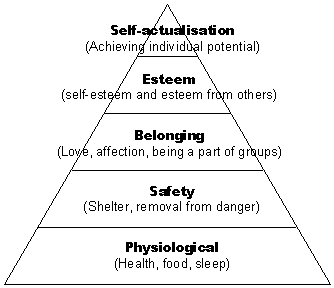
Part of the original inspiration for the trilogy was Maslow's Hierarchy of Needs. Every couple of tiers will be a part of a "section" of Sunburn.

Those in "the know" will be able to call me out on this one almost instantly. Because these are RPG characters, and not real people, they are constantly in Physiological danger. Usually from people with guns. So, I digress, it isn't perfect. But it's close.
Sunburn 1 is the Physiological tier, bordering on the Safety tier. The players will be struggling for water, and fighting against a desert war machine. Sleep and food won't be such a big issue, mainly because as a GM, I don't want to spend a lot of time focusing on them. Maybe later. For now, the survival mechanic is water and bullets. I say "bordering" on the Safety tier because they won't really have removal from danger- the campaign is spent throwing themselves into EMPIRE bunkers, so even I'm calling this one exempt.
Sunburn 2 is the Safety, and Belonging tiers. There will be several factions the players can choose to be buddy-buddy with, and each one comes with their own perks- including a warm bed at night. Of course there's going to be conflict between the groups and their environment, but there's going to be actual people. Also, more hints as to the world of OHS-817. This sets up nicely for the last installment.
Sunburn 3 is about Esteem, with Self-actualisation as a finale. Armed with skills, tools, and knowledge from the previous 2 installments, the players can kick a LOT of ass at this point. But, ass-kicking isn't the focus anymore. It's a huge element, but not the main draw. After what I hope to be one of the most horrible moral decisions I'll force someone to make, the characters will self-actualize. It's going to be the last half hour or so, and it'll set up nicely for whatever campaign I do afterwards. Probably the Spectrum RPG, but I'm not sure yet. Ultimately, it's just supposed to be fulfilling. It's a long, hot, dusty road- and I think the players will enjoy the conclusion.
Because, after all, everyone has their day in the Sun.
Part of the original inspiration for the trilogy was Maslow's Hierarchy of Needs. Every couple of tiers will be a part of a "section" of Sunburn.
Those in "the know" will be able to call me out on this one almost instantly. Because these are RPG characters, and not real people, they are constantly in Physiological danger. Usually from people with guns. So, I digress, it isn't perfect. But it's close.
Sunburn 1 is the Physiological tier, bordering on the Safety tier. The players will be struggling for water, and fighting against a desert war machine. Sleep and food won't be such a big issue, mainly because as a GM, I don't want to spend a lot of time focusing on them. Maybe later. For now, the survival mechanic is water and bullets. I say "bordering" on the Safety tier because they won't really have removal from danger- the campaign is spent throwing themselves into EMPIRE bunkers, so even I'm calling this one exempt.
Sunburn 2 is the Safety, and Belonging tiers. There will be several factions the players can choose to be buddy-buddy with, and each one comes with their own perks- including a warm bed at night. Of course there's going to be conflict between the groups and their environment, but there's going to be actual people. Also, more hints as to the world of OHS-817. This sets up nicely for the last installment.
Sunburn 3 is about Esteem, with Self-actualisation as a finale. Armed with skills, tools, and knowledge from the previous 2 installments, the players can kick a LOT of ass at this point. But, ass-kicking isn't the focus anymore. It's a huge element, but not the main draw. After what I hope to be one of the most horrible moral decisions I'll force someone to make, the characters will self-actualize. It's going to be the last half hour or so, and it'll set up nicely for whatever campaign I do afterwards. Probably the Spectrum RPG, but I'm not sure yet. Ultimately, it's just supposed to be fulfilling. It's a long, hot, dusty road- and I think the players will enjoy the conclusion.
Because, after all, everyone has their day in the Sun.
Subscribe to:
Posts (Atom)