-Asshole NPCs
Too many of my characters are nice people. They're all the same intellectual, optimistic, friendly person I try to be in real life. Bullcrap! Without war there can be no peace, without evil there is no good, and without assholes there are no good people!
The group I usually GM for doesn't consist of a lot of people who take kindly to... negative social interaction. So, my plan is, any "asshole" characters are that way to everyone in general, not just the players. After a while, they might even treat the players a little more kindly. Who knows?
In general, my NPCs just need more contrast. Notice how most quest-givers in RPGs are exactly identical? I'm trying to avoid that. So, in the interests of realism, I'm going to be an absolute jerk.
Why do I get the feeling I've missed something?
-Character Creation
Usually, I spring my story ideas on players last-second. Sometimes because that's when I think of them, but usually because that's how our group rolls. I've decided to change this up a little bit.
For Sunburn, I'm going to give the players a little questionaire. It'll have basic questions to help them visualize their character and decide on a personality, as well as a little bit of flair to get used to the atmosphere of the world. I'll hold off on character creation, that's not quite as important.
-Writing like an entire page for a single part of a Bite-sized thoughts segment
It's a bad habit I'm trying to avoid. But dammit, that movie left an impression!

February 28, 2013

February 26, 2013
Tripping Balls
My productivity is more in the garbage than usual. I've started playing Fallout: New Vegas again. No spoilers, and I'm only going to describe as much of the game as necessary.
I'm Mark, and I have a problem with... well, all the drugs. Fallout is notorious for having at least a dozen different drugs the character can take to alter their stats, get addicted to, and get a lot of money from selling (like any other item- Fallout doesn't put the player in the position of being a dedicated drug dealer). I downloaded a mod which would give each drug its own visual effect. Alcohol makes things grainy, blurry, and double. Jet makes a shaky circle, which grows in size the more you take. The best healing item (The Super Stimpack) makes your vision go purple, skew sideways, and shake rapidly until it wears off.
Good times! I can't wait to get my character hooked on everything under the sun!
Fallout is a "realistic" game, with lots of grays and browns in its palette. See the pic:

It gets a little boring after a while. The pic above was chosen from a series of many, and while not the most accurate, gives a general idea of what most people mean by the "gritty and realistic" art style of most games.
Anyhow. After about five minutes of tripping balls in the post-apocalyptic future (if you haven't, I highly suggest it) I found one drug in particular. Mentats are basically the Fallout version of ecstasy, so they don't get "Drug Use" on the ESRB rating. They'll little chalky pills that boost your intelligence and charisma by an absurd amount, much to the delight of very stupid characters.
I'd used them many times before, but not without the mod. This time I was in for a surprise. The colors suddenly became richer, and more vibrant. There was color! The reds were bold, the greens were earthy without being depressing, and the yellows nearly gave me epilepsy. It was wonderful!
I only realized just how wonderful after the effect faded. It was like any scene from Avatar was filmed in sepia. It felt lonely, dark, and eerily empty. Then it hit me: this is what the withdraws of actual drugs is probably like.
Disclaimer: I have zero drug use. This is mostly speculation, as well as bits from a few conversations I've had with stoners. Don't do drugs.
A gameplay element, meant as a humorous visual addition, simulated an actual aftermath from a trip. This gave me more insight into the appeal of actually using.
Note: This character was optimized to be a drug-guzzling machine. Lots of endurance in his stats to avoid getting the in-game "addiction" (penalties while you're not on something). I never actually got addicted from the game's perspective, despite ingesting no less than 5 pounds on a daily basis.
I've played New Vegas a lot of times. I know the sights. But, seeing them again in technicolor had appeal. It was like something totally new, and all I had to do was crunch a few pills in-game. I had happiness, or something similar, equipped in my inventory.
Of course it sucked to run out. Same brown wasteland, same gray dirt. I spent lots of money- even traded food (not totally important in the game, but still)- for more drugs. I was desperate to get a fix for a digital character I had heavy ties with. To an outside observer, this character was an addict. So, by extension, I was an addict. I needed my color fix, or else life (AKA the game) wasn't as fun as I wanted it to be. Just like how some people describe real life.
Even if it's just digital, video games still contain many parallels to real life. I'm not a druggie, stoner, or what have you. But in that place, with a little packet I got off the internet, I got to see the world through their eyes.
Now, if only I could download a support group.
I'm Mark, and I have a problem with... well, all the drugs. Fallout is notorious for having at least a dozen different drugs the character can take to alter their stats, get addicted to, and get a lot of money from selling (like any other item- Fallout doesn't put the player in the position of being a dedicated drug dealer). I downloaded a mod which would give each drug its own visual effect. Alcohol makes things grainy, blurry, and double. Jet makes a shaky circle, which grows in size the more you take. The best healing item (The Super Stimpack) makes your vision go purple, skew sideways, and shake rapidly until it wears off.
Good times! I can't wait to get my character hooked on everything under the sun!
Fallout is a "realistic" game, with lots of grays and browns in its palette. See the pic:

It gets a little boring after a while. The pic above was chosen from a series of many, and while not the most accurate, gives a general idea of what most people mean by the "gritty and realistic" art style of most games.
Anyhow. After about five minutes of tripping balls in the post-apocalyptic future (if you haven't, I highly suggest it) I found one drug in particular. Mentats are basically the Fallout version of ecstasy, so they don't get "Drug Use" on the ESRB rating. They'll little chalky pills that boost your intelligence and charisma by an absurd amount, much to the delight of very stupid characters.
I'd used them many times before, but not without the mod. This time I was in for a surprise. The colors suddenly became richer, and more vibrant. There was color! The reds were bold, the greens were earthy without being depressing, and the yellows nearly gave me epilepsy. It was wonderful!
I only realized just how wonderful after the effect faded. It was like any scene from Avatar was filmed in sepia. It felt lonely, dark, and eerily empty. Then it hit me: this is what the withdraws of actual drugs is probably like.
Disclaimer: I have zero drug use. This is mostly speculation, as well as bits from a few conversations I've had with stoners. Don't do drugs.
A gameplay element, meant as a humorous visual addition, simulated an actual aftermath from a trip. This gave me more insight into the appeal of actually using.
Note: This character was optimized to be a drug-guzzling machine. Lots of endurance in his stats to avoid getting the in-game "addiction" (penalties while you're not on something). I never actually got addicted from the game's perspective, despite ingesting no less than 5 pounds on a daily basis.
I've played New Vegas a lot of times. I know the sights. But, seeing them again in technicolor had appeal. It was like something totally new, and all I had to do was crunch a few pills in-game. I had happiness, or something similar, equipped in my inventory.
Of course it sucked to run out. Same brown wasteland, same gray dirt. I spent lots of money- even traded food (not totally important in the game, but still)- for more drugs. I was desperate to get a fix for a digital character I had heavy ties with. To an outside observer, this character was an addict. So, by extension, I was an addict. I needed my color fix, or else life (AKA the game) wasn't as fun as I wanted it to be. Just like how some people describe real life.
Even if it's just digital, video games still contain many parallels to real life. I'm not a druggie, stoner, or what have you. But in that place, with a little packet I got off the internet, I got to see the world through their eyes.
Now, if only I could download a support group.
February 21, 2013
Bite-sized thoughts 3
-Good and Evil
I still feel like I'm missing part of this dilemma.
"Evil" is anything I don't like. If lots of people agree with me, it's definitely evil. The enemy is evil. Their god is evil. Starvation is evil. But, I'm good. I'm very good. I only kill people if they're evil. They say the same thing, but of course that's just because they don't have my god. He's a good god. He tells me who's evil. And anyone who follows him is good.
I, personally, believe "good" and "evil" are hyper-extensions of selflessness versus selfishness. Humans are very social creatures, despite what we'd like to believe. We need numbers to thrive, just like ants. Anyone who takes from the common collective is evil, because they are putting themselves over other people. Alternatively, "good" people give things. Equality, money, their lives, etc.
Robbery is evil because someone takes money.
Lust is evil because someone takes love.
Murder is evil because someone takes life.
Notice a pattern yet?
-The players can help, too
I was reading an article about Luke Crane (the guy behind Burning Wheel). At one point he split the party for a few rooms, and had the players who weren't present play as some goblins. This strikes me as a really fun approach
-Actions are methods, not motivations
I saw the movie "Goon" (2011) the other day. It was, to me, an antithesis to Man on Wire. Also a completion.
SPOILERS
Doug Glatt is in it for the violence. He's a hockey player, formerly bouncer, whose job is to beat the crap out of anyone who has a remote strategic advantage on the ice. But, he's only violent on the field (and when people piss him off in bars).
Violence was not his motivation- actually, a sense of belonging was. He wanted to be part of the team, and punching people's teeth in is just how he does that. Off the field, he's just a big guy. One of my favorite parts of the whole movie is when he walks into a restaurant, and has a conversation with his biggest rival, who he's itching to fight for the first time. They sit down, Doug learns a few things from a veteran, and shows his enthusiasm for the game. His rival leaves, and that's it. It was such a powerful scene, where two titans turn off their testosterone and act like two normal people. Friends, even.
There's another arc involving his love interest. He walks her home, it looks like they're in love, then she calls him to let him know she has a boyfriend, and she's really sorry about leading him on. Doug isn't sure how to respond to this. Of course we all think he's going to beat the crap out of her girly, yuppie boyfriend, because that's what happens in high school. Instead, we're surprised with a very sane answer. Doug focuses his efforts on being with the team, and drinking beer with his best buddy- just like before. I did a double-take when I saw this, because it was not at all what I was expecting out of someone who has been nicknamed "The Thug" by his fans.
All this shocked me a little bit, but I had an important realization: The means are not the end. Doug's greatness isn't beating people senseless, his greatness is in his team, and how he contributes to them- by beating people senseless. In the same way, Philippe from Man on Wire wasn't great because of his tightrope-walking, it was because of his ambition. The walk was just how he expressed it, and built up to it.
So, now that I've written a full-sized post in a Bite-sized thoughts segment, let me get to the point. The character's (and hopefully player's) motivation isn't the same way as how they get there. If you want to be a good athlete, you're building a legacy and community around yourself- not just running in circles to feel better. Just the same, people who want real change and a voice to be heard take up protesting. Not that I think that is the best course of action, it's just what they thought was best.
As a GM, I realize there has to be a motivation other than skill itself. I couldn't just tell the players to go tight-rope walk between the WTC towers, I'd have to convince them (through their characters) it's about image, and spectacle. The walk itself is just the means to the end.
I still feel like I'm missing part of this dilemma.
"Evil" is anything I don't like. If lots of people agree with me, it's definitely evil. The enemy is evil. Their god is evil. Starvation is evil. But, I'm good. I'm very good. I only kill people if they're evil. They say the same thing, but of course that's just because they don't have my god. He's a good god. He tells me who's evil. And anyone who follows him is good.
I, personally, believe "good" and "evil" are hyper-extensions of selflessness versus selfishness. Humans are very social creatures, despite what we'd like to believe. We need numbers to thrive, just like ants. Anyone who takes from the common collective is evil, because they are putting themselves over other people. Alternatively, "good" people give things. Equality, money, their lives, etc.
Robbery is evil because someone takes money.
Lust is evil because someone takes love.
Murder is evil because someone takes life.
Notice a pattern yet?
-The players can help, too
I was reading an article about Luke Crane (the guy behind Burning Wheel). At one point he split the party for a few rooms, and had the players who weren't present play as some goblins. This strikes me as a really fun approach
-Actions are methods, not motivations
I saw the movie "Goon" (2011) the other day. It was, to me, an antithesis to Man on Wire. Also a completion.
SPOILERS
Doug Glatt is in it for the violence. He's a hockey player, formerly bouncer, whose job is to beat the crap out of anyone who has a remote strategic advantage on the ice. But, he's only violent on the field (and when people piss him off in bars).
Violence was not his motivation- actually, a sense of belonging was. He wanted to be part of the team, and punching people's teeth in is just how he does that. Off the field, he's just a big guy. One of my favorite parts of the whole movie is when he walks into a restaurant, and has a conversation with his biggest rival, who he's itching to fight for the first time. They sit down, Doug learns a few things from a veteran, and shows his enthusiasm for the game. His rival leaves, and that's it. It was such a powerful scene, where two titans turn off their testosterone and act like two normal people. Friends, even.
There's another arc involving his love interest. He walks her home, it looks like they're in love, then she calls him to let him know she has a boyfriend, and she's really sorry about leading him on. Doug isn't sure how to respond to this. Of course we all think he's going to beat the crap out of her girly, yuppie boyfriend, because that's what happens in high school. Instead, we're surprised with a very sane answer. Doug focuses his efforts on being with the team, and drinking beer with his best buddy- just like before. I did a double-take when I saw this, because it was not at all what I was expecting out of someone who has been nicknamed "The Thug" by his fans.
All this shocked me a little bit, but I had an important realization: The means are not the end. Doug's greatness isn't beating people senseless, his greatness is in his team, and how he contributes to them- by beating people senseless. In the same way, Philippe from Man on Wire wasn't great because of his tightrope-walking, it was because of his ambition. The walk was just how he expressed it, and built up to it.
So, now that I've written a full-sized post in a Bite-sized thoughts segment, let me get to the point. The character's (and hopefully player's) motivation isn't the same way as how they get there. If you want to be a good athlete, you're building a legacy and community around yourself- not just running in circles to feel better. Just the same, people who want real change and a voice to be heard take up protesting. Not that I think that is the best course of action, it's just what they thought was best.
As a GM, I realize there has to be a motivation other than skill itself. I couldn't just tell the players to go tight-rope walk between the WTC towers, I'd have to convince them (through their characters) it's about image, and spectacle. The walk itself is just the means to the end.
February 19, 2013
My design strategy
Something simple this time. I thought about putting it in Bite-sized thoughts 3, but I want this to be a little more visible.
If you take a story (fiction, of course) and break it down to its most basic form, it's ridiculous.
If you take a story (fiction, of course) and break it down to its most basic form, it's ridiculous.
- A midget and his friends must destroy the most evil piece of jewelry in the world
- Four kids enter a wardrobe, trip balls, and see a lion
Some liberties may have been taken in these summaries.
This effect can be reversed. Start with something completely ridiculous, then play it straight-faced. I'm not going to toot my own horn on this one, instead I'm going to let you look at what I've posted and theorized, and let you make up your own opinions.
Things will start to get really weird once I get into the Spectrum RPG. Until then, Sunburn shows this design philosophy slightly.
February 17, 2013
Sunburn Trilogy
I've put some more thought into it, and Sunburn is definitely going to be a trilogy. Partially because I want the players to know a campaign, as opposed to a mission, but also because I have too many ideas to just throw them all into Sunburn 1.
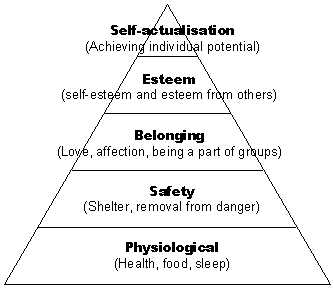
Part of the original inspiration for the trilogy was Maslow's Hierarchy of Needs. Every couple of tiers will be a part of a "section" of Sunburn.

Those in "the know" will be able to call me out on this one almost instantly. Because these are RPG characters, and not real people, they are constantly in Physiological danger. Usually from people with guns. So, I digress, it isn't perfect. But it's close.
Sunburn 1 is the Physiological tier, bordering on the Safety tier. The players will be struggling for water, and fighting against a desert war machine. Sleep and food won't be such a big issue, mainly because as a GM, I don't want to spend a lot of time focusing on them. Maybe later. For now, the survival mechanic is water and bullets. I say "bordering" on the Safety tier because they won't really have removal from danger- the campaign is spent throwing themselves into EMPIRE bunkers, so even I'm calling this one exempt.
Sunburn 2 is the Safety, and Belonging tiers. There will be several factions the players can choose to be buddy-buddy with, and each one comes with their own perks- including a warm bed at night. Of course there's going to be conflict between the groups and their environment, but there's going to be actual people. Also, more hints as to the world of OHS-817. This sets up nicely for the last installment.
Sunburn 3 is about Esteem, with Self-actualisation as a finale. Armed with skills, tools, and knowledge from the previous 2 installments, the players can kick a LOT of ass at this point. But, ass-kicking isn't the focus anymore. It's a huge element, but not the main draw. After what I hope to be one of the most horrible moral decisions I'll force someone to make, the characters will self-actualize. It's going to be the last half hour or so, and it'll set up nicely for whatever campaign I do afterwards. Probably the Spectrum RPG, but I'm not sure yet. Ultimately, it's just supposed to be fulfilling. It's a long, hot, dusty road- and I think the players will enjoy the conclusion.
Because, after all, everyone has their day in the Sun.
Part of the original inspiration for the trilogy was Maslow's Hierarchy of Needs. Every couple of tiers will be a part of a "section" of Sunburn.
Those in "the know" will be able to call me out on this one almost instantly. Because these are RPG characters, and not real people, they are constantly in Physiological danger. Usually from people with guns. So, I digress, it isn't perfect. But it's close.
Sunburn 1 is the Physiological tier, bordering on the Safety tier. The players will be struggling for water, and fighting against a desert war machine. Sleep and food won't be such a big issue, mainly because as a GM, I don't want to spend a lot of time focusing on them. Maybe later. For now, the survival mechanic is water and bullets. I say "bordering" on the Safety tier because they won't really have removal from danger- the campaign is spent throwing themselves into EMPIRE bunkers, so even I'm calling this one exempt.
Sunburn 2 is the Safety, and Belonging tiers. There will be several factions the players can choose to be buddy-buddy with, and each one comes with their own perks- including a warm bed at night. Of course there's going to be conflict between the groups and their environment, but there's going to be actual people. Also, more hints as to the world of OHS-817. This sets up nicely for the last installment.
Sunburn 3 is about Esteem, with Self-actualisation as a finale. Armed with skills, tools, and knowledge from the previous 2 installments, the players can kick a LOT of ass at this point. But, ass-kicking isn't the focus anymore. It's a huge element, but not the main draw. After what I hope to be one of the most horrible moral decisions I'll force someone to make, the characters will self-actualize. It's going to be the last half hour or so, and it'll set up nicely for whatever campaign I do afterwards. Probably the Spectrum RPG, but I'm not sure yet. Ultimately, it's just supposed to be fulfilling. It's a long, hot, dusty road- and I think the players will enjoy the conclusion.
Because, after all, everyone has their day in the Sun.
February 12, 2013
Talking Heads
Something a little different this time.
One of the hardest parts I have with GMing is keeping characters distinctive. To remedy this, I had the idea to use something like flash cards.


With just a glance, you could look down and get a rough idea of how to act out each character. The pictures are mainly just for quick identification.
The words are there to bring up the most likely tone of response. GUIDE is encouraging by default, but occasionally lapses into history, being very well educated. If the players elicit a further response, GUIDE's vulnerable side bleeds through.
The cards can't tell a complete story. I knew from the get-go that GUIDE is afraid of dying, even though it's artificial. That's mainly just there as a reminder. If possible, the response will be historical/factual, or encouraging in any way. GUIDE's a good guy.
Mister Fixer is a different story. He's a tough guy, who drives muscle cars and lifts weights. His day job is assassination, something he doesn't hide. If he can't think of a "tough" thing to add to a conversation, he'll tell a little story about his line of work. And, at the very core, his dirty secret- he's a proud father. This adds a little bit of character depth, and as the players get to know him more, he'll probably open up about it. Probably. Maybe. Possibly.
The quotes at the bottom are just a little phrase to help identify the speaker. I plan to have it show up at least once in every conversation, to reinforce the character. Obviously, the phrase is kept as open as possible to let it be spliced into any part of speech.
One of the hardest parts I have with GMing is keeping characters distinctive. To remedy this, I had the idea to use something like flash cards.


With just a glance, you could look down and get a rough idea of how to act out each character. The pictures are mainly just for quick identification.
The words are there to bring up the most likely tone of response. GUIDE is encouraging by default, but occasionally lapses into history, being very well educated. If the players elicit a further response, GUIDE's vulnerable side bleeds through.
The cards can't tell a complete story. I knew from the get-go that GUIDE is afraid of dying, even though it's artificial. That's mainly just there as a reminder. If possible, the response will be historical/factual, or encouraging in any way. GUIDE's a good guy.
Mister Fixer is a different story. He's a tough guy, who drives muscle cars and lifts weights. His day job is assassination, something he doesn't hide. If he can't think of a "tough" thing to add to a conversation, he'll tell a little story about his line of work. And, at the very core, his dirty secret- he's a proud father. This adds a little bit of character depth, and as the players get to know him more, he'll probably open up about it. Probably. Maybe. Possibly.
The quotes at the bottom are just a little phrase to help identify the speaker. I plan to have it show up at least once in every conversation, to reinforce the character. Obviously, the phrase is kept as open as possible to let it be spliced into any part of speech.
- MF (see what I did there? =D) Blows up a car: Too easy.
- During a set-up: Anyone else think this is a little too easy?
- Talking about cars: ... Makes it too easy. A child could do it.
It's just a GM aid, ultimately. I have no guarantee this will improve anyone's ability, or concentration. In fact, it might be too distracting. I'll have to find out myself.
But, if it helps, go for it!
Subscribe to:
Posts (Atom)